About Conospermum caeruleum R.Br.
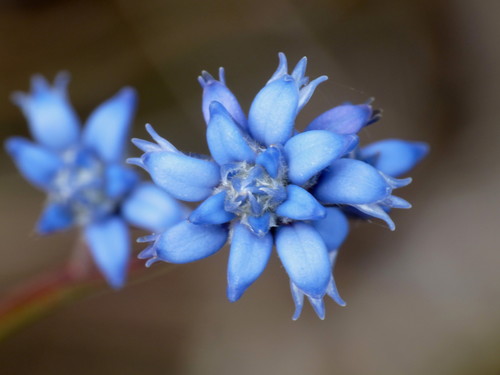
Conospermum caeruleum R.Br. is a prostrate or straggly shrub. It typically reaches 0.5 to 1.0 metres (2 to 3 ft) in height, and can spread up to 2 metres (7 ft) across. Its leaves grow in clusters at the base of the stem; each leaf has a 5–60 millimetre (0.2–2 in) long stalk, and a leaf blade ranging from thread-like to egg-shaped, measuring 14–148 millimetres (0.6–6 in) long. Leaves have prominent veins and end abruptly in a sharp point. The flowers form dense clusters containing up to 18 individual tube-like blue flowers, each 5–8 millimetres (0.2–0.3 in) long. Flowering occurs between July and October. After flowering, the plant produces a nut-like fruit, around 2 millimetres (0.08 in) long and 2–2.5 millimetres (0.08–0.1 in) wide. This species is found between Busselton and east of Albany, across the Avon Wheatbelt, Esperance, Geraldton Sandplains, Jarrah Forest, Mallee, Swan Coastal Plain and Warren biogeographical regions of Western Australia. It grows on sand, sandy peat, stony clay, laterite or granite, in locations that are wet during winter. Like other Conospermum species, especially those native to Western Australia, Conospermum caeruleum is difficult to cultivate for horticulture.