About Coeligena helianthea (R.Lesson, 1839)
Common Name and Length
Coeligena helianthea, commonly known as the blue-throated starfrontlet, is approximately 13 cm (5.1 in) long.
Weight
Males weigh 7.1 to 7.6 g (0.25 to 0.27 oz), and females weigh 6 to 6.5 g (0.21 to 0.23 oz).
Shared Morphological Features
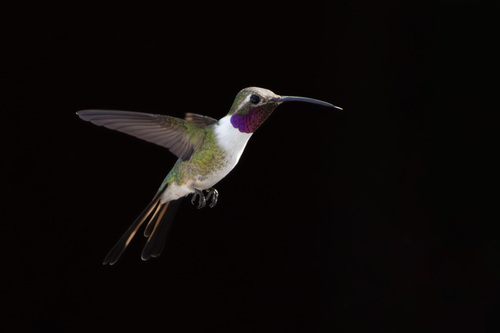
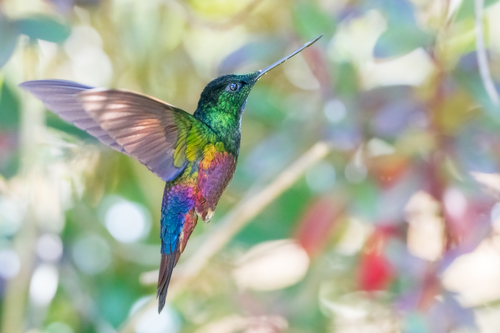
Both sexes have a long, straight black bill and a white spot behind the eye, and both have bronzy black forked tails, though the female’s tail is less indented than the male’s.
Appearance in Poor Light
The species can appear entirely dark in poor light.
Nominate Male Head Coloration
Males of the nominate subspecies have a black head with a dark green forehead.
Nominate Male Upperpart Coloration
Their upperparts are dark with an emerald green gloss, while their lower back and rump are dark blue with hints of violet.
Nominate Male Underpart Coloration
They have a dark iridescent violet throat, a dark gray breast with an emerald green sheen, and a rosy belly, vent area, and undertail coverts.
Nominate Female Head and Upperpart Coloration
Nominate subspecies females have a gray-green head including the forehead, and golden green upperparts that transition to a blue-violet rump; all of the female's colors are duller than the male's.
Nominate Female Throat and Breast Coloration
The female's throat and breast are rufous, with green spots on the breast.
Nominate Female Belly and Undertail Covert Coloration
The female's belly is rosy, and the undertail coverts are a paler rose.
C. h. tamai Male Features
Males of subspecies C. h. tamai are very similar to nominate males but are duller overall, with bellies and undertail coverts that are more bluish than rosy.
C. h. tamai Female Features
C. h. tamai females are essentially identical to nominate females.
Nominate Subspecies Distribution
The nominate subspecies of blue-throated starfrontlet occurs in the northern and eastern Andes of Colombia, ranging from Serranía del Perijá (which spans the border between northern Colombia and northwestern Venezuela) south and west to the Metropolitan Area of Bogotá.
C. h. tamai Distribution
Subspecies C. h. tamai is found in the Tamá Massif in Táchira, a western Venezuelan state.
Habitat
This species inhabits the interior and edges of cloudforest and elfin forest, as well as shrubby slopes, and sometimes occupies bushy landscapes at the lower margin of páramo.
Anthropogenic Habitat Use
It also occurs in flowering gardens.
Elevation Range
It is found at elevations ranging from 1,900 to 3,300 m (6,200 to 10,800 ft).