About Eugenes spectabilis (Lawrence, 1867)
Taxonomic Identification
The Talamanca hummingbird (scientific name Eugenes spectabilis (Lawrence, 1867)) is approximately 13 cm (5.1 in) long.
Size and Weight
Males weigh about 10 g (0.35 oz), while females weigh around 8.5 g (0.30 oz).
Shared Morphological Features
Both sexes share a long straight black bill and a small white spot behind the eye.
Adult Male Head Plumage
Adult males have a dull black forehead with dark green gloss, a metallic violet blue to purple crown, and dull black nape and upper back. Most of the face is dark green, and the lores are deep black.
Adult Male Upperparts and Tail
The remaining upperparts and the tail are bronzy green to golden green; tail feathers sometimes have grayish tips.
Adult Male Underparts
The chin and gorget are metallic bluish green, and the breast and belly are dark bronzy green, with brownish gray mixed into the belly. Undertail coverts are dull bronzy green with pale buff edges.
Adult Female Key Plumage Differences
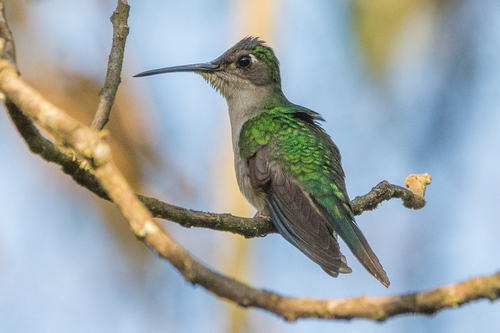
Adult females lack the male's iridescent crown and gorget.
Adult Female Upperparts and Head
Their upperparts are dull dark green, and most of the face is sooty black.
Adult Female Tail Plumage
The two innermost pairs of tail feathers are also dull dark green, while the three outer pairs are bronzy green with a black band near the tip and brownish gray tips.
Adult Female Underparts
The throat is brownish gray with buff feather tips, flanks are dark green, and the breast, belly, and undertail coverts are dull brownish gray with a muted green wash.
Immature Plumage
Immature birds resemble adult females, but have darker brown underparts with a dull buff scaly pattern. Feathers on the upperparts, especially those on the crown and neck, have buffy fringes.
General Distribution
The Talamanca hummingbird is found in mountains from central Costa Rica into western Panama.
Country-Specific Range
In Costa Rica, it occurs in the Cordillera Central and Cordillera de Talamanca, while in Panama it is only found in the Volcán Barú massif of Chiriquí Province.
Habitat Preferences
It inhabits oak forests, and prefers forest edges and clearings; it is also found in nearby secondary forest.
Elevational Range in Costa Rica
In Costa Rica it occurs from 2,000 m (6,600 ft) up to treeline, but is most common above 2,500 m (8,200 ft) and is occasionally found as low as 1,850 m (6,100 ft).
Elevational Range in Panama
In Panama it occurs between 2,000 and 2,400 m (6,600 and 7,900 ft).