About Cleretum bellidiforme (Burm.fil.) G.D.Rowley
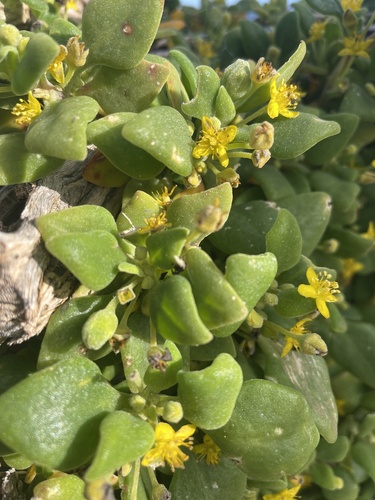
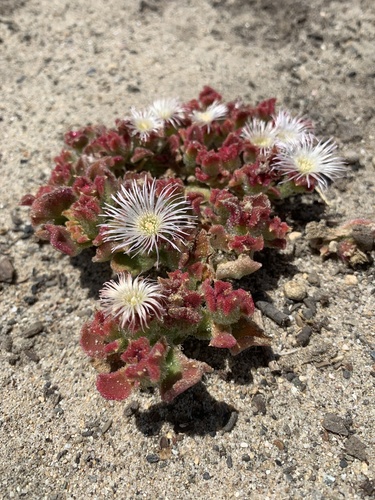
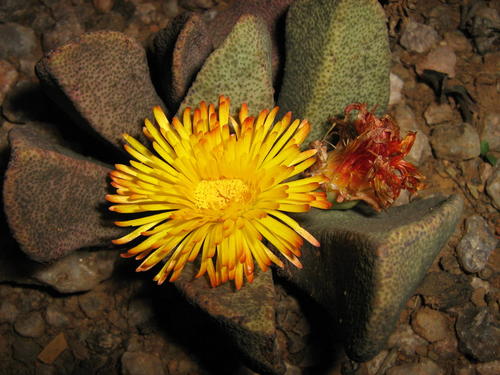
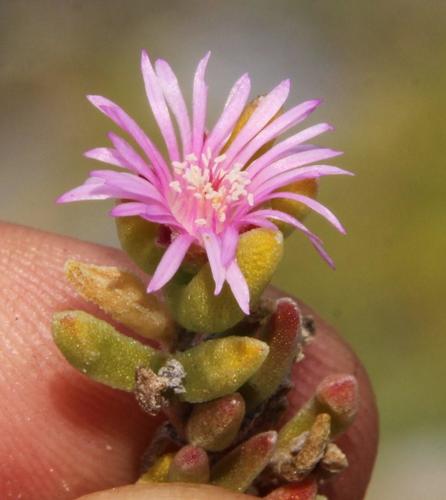
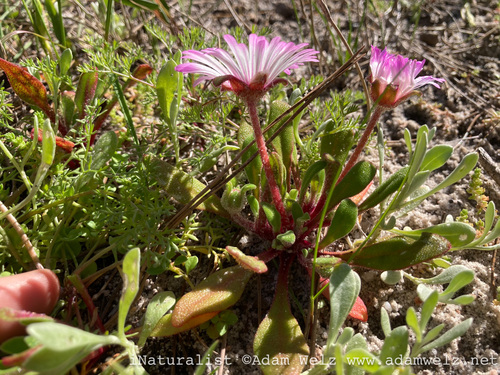
Cleretum bellidiforme is an annual succulent that grows during the winter. It produces green or slightly maroon leaves, which are flat with rounded tips. The leaf surface has distinct bladder-shaped cells that store water and give the leaves a reflective appearance. The plant typically grows as a stout low-growing groundcover, while its flowering stems can reach up to 25 cm (10 in) tall.
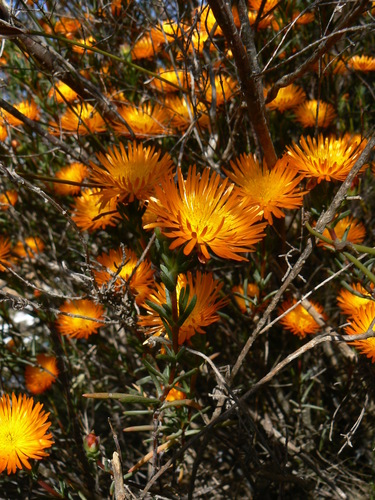
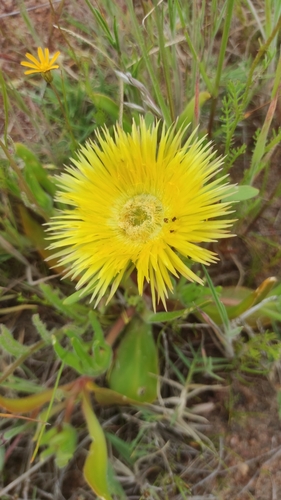
Flowers are borne singly, are brightly colored, and have many narrow petals. They open in bright sunlight, and can grow up to 30 millimetres (1.2 in) across. In the center of the flower, maroon stamens are arranged in rows, and carry purple or yellow anthers. The ovary sits below the stamens. After flowering, the plant produces a five-chambered capsule fruit that expands in wet conditions to release very small, smooth, light brown seeds.
C. bellidiforme is found only in the winter rainfall regions of western South Africa, and grows mostly in the western half of the Western Cape. In the Northern Cape, it is limited to desert areas that border the Western Cape, northwest of the Cederberg, and inland from the southern stretch of the Atlantic coast. Its distribution is patchy rather than continuous. It is very common in Bokbaai, where it flowers in large numbers during spring.
This species is adapted to grow in disturbed sand, such as that found on riverbanks or desert dunes. Its small, flat seeds easily sink deeper into loose sand to stay sheltered from the summer sun. It can also be found growing on clay slopes, limestone ridges and granite outcrops. It is very short-lived: seeds germinate with the first autumn rains, and plants grow and flower from late winter to spring, between July and October. Flowers can self-pollinate. It grows in fynbos and succulent karoo habitats. It sometimes grows alongside low-growing Oxalis and Senecio, and can occur as a single individual or in large colonies.
It is a well-known popular garden annual grown in many parts of the world, and seed is available in many different flower color forms. Seed catalogues often list it under one of its synonyms. Seeds may be sown in a cold frame, and the plant grows best in frost-free areas with low moisture. The former subspecies C. hestermalense has seeds that are difficult to germinate, and germinate best when kept hot and dry over the summer. It can be grown successfully in household containers such as window boxes, troughs, and pots, in locations that receive many hours of sun. If grown in soil with poor drainage, roots can easily be killed by fungal infection.
Cleretum bellidiforme is mainly used around the world for ornamental purposes.