About Tetragonia implexicoma (Miq.) Hook.fil.
Nomenclature
Commonly known as bower spinach, this species has the scientific name Tetragonia implexicoma (Miq.) Hook.fil.
Growth Habit
It is a scrambling subshrub that forms dense, leafy patches that can reach up to 4 metres (13 ft) across.
Stem Characteristics
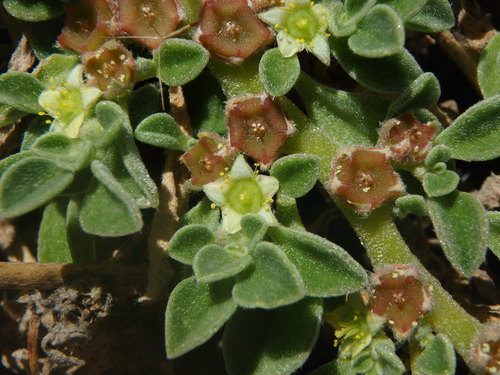
Its stems are long and trailing, often succulent; young stems are coloured red or pink, while mature stems darken to dark green, brown, or black and become woody.
Leaf Characteristics
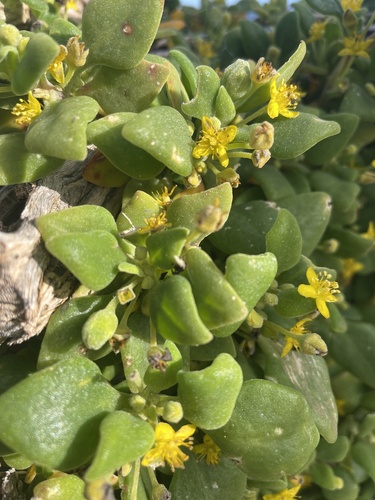
Its leaves grow in an alternate arrangement, are clustered and semi-succulent, and range in shape from rhombic to angular-ovate. Young leaves sometimes bear coarse hairs.
Flower Characteristics
Bower spinach produces solitary, strongly scented yellow flowers, which have 12 to 20 stamens and 2 styles. Its flowering period runs from August to November.
Fruit Characteristics
The fruits are 5–8 millimetres (0.20–0.31 in) long, pink to dark red, succulent berries, which are eaten by birds and lizards.
Human Use
This species is currently planted on Phillip Island for use as a fire retardant plant.
Geographical Distribution
Bower spinach occurs mainly in coastal regions of New Zealand and southern Australia, as well as on many nearby island groups.
Coastal Habitat
It grows in a wide variety of habitats, including sand and shingle beaches, coastal woodland, coastal shrubland, coastal grassland, and exposed, salt-pruned vegetation on cliffs and stacks.
Inland Habitat
It can also be found growing well inland: in farmland where it is grown in barberry hedges, and on calcareous sandstone or limestone outcrops within dense forest.