About Mesembryanthemum crystallinum L.
Stem and Leaf Morphology
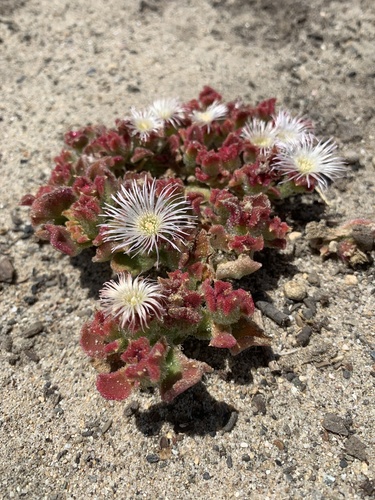
Mesembryanthemum crystallinum L. produces creeping stems that reach 20–60 centimetres (8–23+1⁄2 inches) in length, with leaves that grow 2–10 cm (3⁄4–4 in) long.
Flowering Characteristics
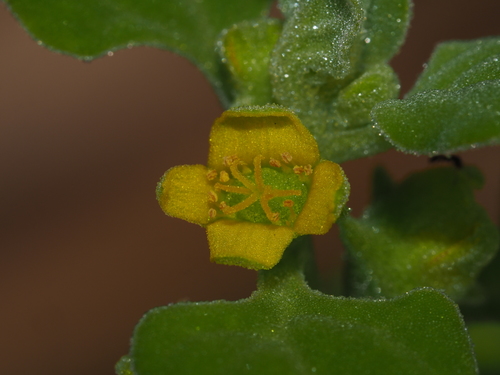
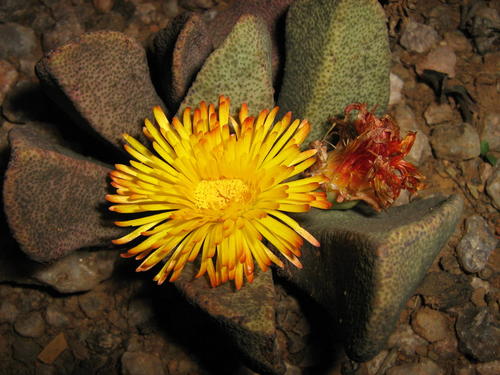
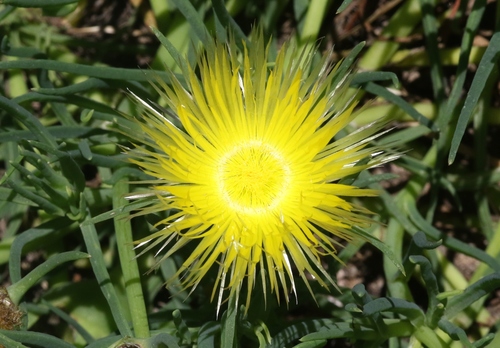
It flowers from March to October; its many-petalled flowers are 2.5 cm (1 in) across, open in the morning and close at night, and are pollinated by insects.
Epidermal Cell Function
The entire species is covered with enlarged epidermal cells called "bladder cells", whose main function is water storage.
Life Cycle
This plant can be annual, biennial or perennial, but its life cycle is usually completed within several months, depending on environmental conditions.
Native and Naturalized Range
Mesembryanthemum crystallinum is native to Africa, Sinai, and southern Europe, and has become naturalized in the Southwest of North America, as well as in South America and Australia.
Soil Type Tolerance
It grows across a wide range of soil types, from well-drained sandy soils including sand dunes, to loamy and clay soils.
Habitat Adaptations
It tolerates nutritionally poor or saline soils, classifying it as a halophile, and grows well in disturbed sites such as roadsides, rubbish dumps, and homestead yards.
Invasive Status
M. crystallinum is listed as an invasive species in North America, South America, and Australia.
Invasive Competitive Traits
Its ability to grow in poor quality or saline soils and preference for disturbed areas are traits shared by many invasive plants that allow it to outcompete native species.
Soil Salinization Mechanism
In addition, salt sequestered over the plant's lifetime leaches into the soil after the plant dies, creating an environment where the seeds of other plants struggle to germinate.
Colonization Advantage
This lets M. crystallinum colonize new areas with very little competition.
Livestock Grazing
The plant is rarely, if ever, grazed by domestic livestock.
Edible Leaves
Like some other members of the family Aizoaceae, the leaves of M. crystallinum are edible.
Historical Promotion as Vegetable
It was once promoted as a spinach-like vegetable in the United States and Europe, but failed to gain popularity.
Southern Africa Culinary Use
In southern Africa, wild-harvested leaves and stems are pickled.
Japanese Commercial Cultivation
In Japan, after Saga University successfully hydroponically cultivated a commercial quantity of the species in 2009, it became a common vegetable sold in supermarkets, where it is sold under the names ice plant (アイスプラント), salt leaf (ソルトリーフ), and barafu (バラフ).
Edible Seeds
The seeds of the species are also edible.
Crushed Leaf Uses
Crushed leaves can be used as a soap substitute, and have medicinal uses.
Firescaping Use
In South Africa, ice plants are also used to deter fires, or for "firescaping" gardens.
Ornamental Cultivation
It is also cultivated as an ornamental plant.
Bioremediation Potential
Due to its salt accumulation ability, M. crystallinum may be useful for bioremediation.