About Clematis hirsutissima Pursh
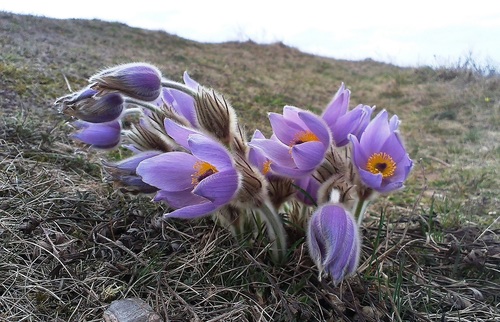
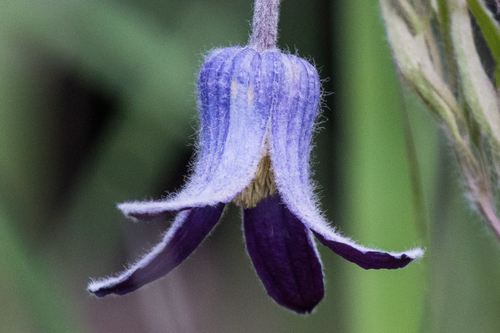
Clematis hirsutissima Pursh is a species of flowering plant in the buttercup family, with the common names hairy clematis or vase flower. It is a perennial herb native to a large portion of the western United States, ranging from Washington to Nebraska. This is a small, erect plant that, unlike most other Clematis species, does not typically grow vines. Its overall appearance is quite variable, particularly between its different varieties. Generally, its hairy stem grows to about half a meter in height, and holds many large hairy leaves divided into lance-shaped lobes. An inflorescence forms at the tip of the stem, holding a single solitary flower. The flower is shaped like an urn-shaped cup made of deep purple-blue petal-like sepals; these sepals are fuzzy, and have either pointed or rounded tips. Rare individual plants have white or pinkish sepals instead. This species has no true petals. Its fruit is a hairy achene that has a very long beak, with a plume at the end, and the fruit is dispersed by wind. The roots of this plant are large, grow deep into the ground, and are extensively branched. They form a large crown that holds many dormant buds. The plant is often dormant during the summer. It naturally grows in grasslands, sagebrush plains, and ponderosa forests. The variety Clematis hirsutissima var. scottii is valued for use in xeriscaping and rock gardening, especially within its native range. Well-established plants produce a compact mound of foliage and many blossoms, which many people consider attractive, including well-known wildflower writer Claude A. Barr. This variety can be successfully divided for vegetative reproduction.