About Anemone coronaria L.
Plant Type
Anemone coronaria L. is a herbaceous, perennial, tuberous plant.
Size
It typically grows 20 to 40 cm (7.9 to 15.7 in) tall, and rarely reaches 60 cm (24 in), spreading 15 to 23 cm (5.9 to 9.1 in) wide.
Foliage
It forms a basal rosette of a small number of leaves; each leaf has three leaflets, and each leaflet is deeply lobed.
Flowering Period
Single flowers bloom from April to June, borne on tall stems that have a whorl of small leaves just below the flower.
Flower Structure
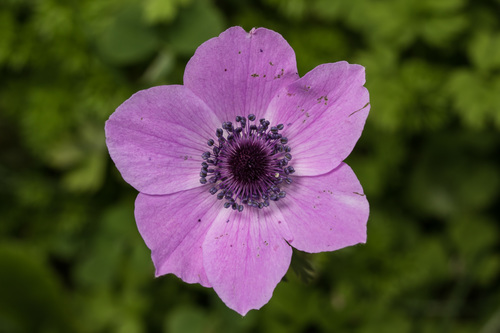
Each flower measures 3 to 8 cm in diameter, with 5 to 8 showy, petal-like tepals that are most often red, but may also be white or blue, and a black central region.
Pollen Traits
Its pollen is dry, has an unsculpted exine, measures less than 40 nm in diameter, and is usually deposited within 1.5 meters of its source.
Etymology
The central mound of the flower is made up of tightly packed pistils, with a crown-like ring of stamens surrounding it—this structure gives the species its specific epithet coronaria.
Reproductive Organs
Each flower produces 200 to 300 seeds, and the plant forms hard black tubers to use as storage organs.
Similar Species
Aside from bearing flowers that resemble poppies, the red single wild form of Anemone coronaria has flowers similar to those of the red single wild form of Ranunculus asiaticus.
Native Range
This species is found along the Mediterranean littoral, ranging from Greece, Albania, southern Turkey, Syria, Iraq, and northern Arabia to the Sinai Peninsula.
Extended Distribution
It extends sporadically east to Iran, and west along the Mediterranean shores of Italy, southern France, and North Africa.
Wild Ecology
In its wild habitat, A. coronaria flowers in winter, and is cross-pollinated by bees, flies, and beetles, which can carry its pollen over long distances.
Introduction to England
Anemone coronaria was introduced to England before 1596, and it was described in Thomas Johnson's 1597 edition of John Gerard's Herball.
Early Cultivation Popularity
It was already popular during the reign of Queen Elizabeth I.
Cultivar Development
By the start of the 18th century, breeders in France and Italy had already greatly expanded the range of flower colours available in cultivated varieties.
Modern Cultivation Purpose
Today, Anemone coronaria is widely grown for its decorative flowers.
Hardiness and Light Requirements
It is hardy in USDA zones 7 through 10, and prefers full sun to partial shade.
Climate Adaptation
While it grows as a perennial in its native climate, it is typically grown as an annual from tubers in cooler climates.
Planting Guidelines
Tubers are usually planted in autumn when plants are kept potted in a greenhouse over winter, or planted in the ground in spring once all risk of frost has passed.