About Claudius angustatus Cope, 1865
Coloration
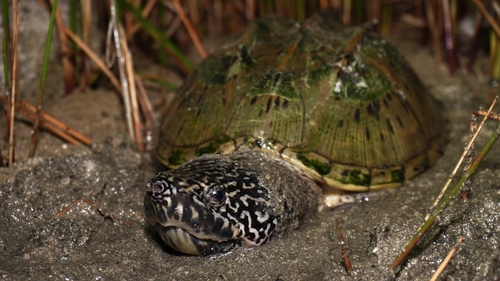
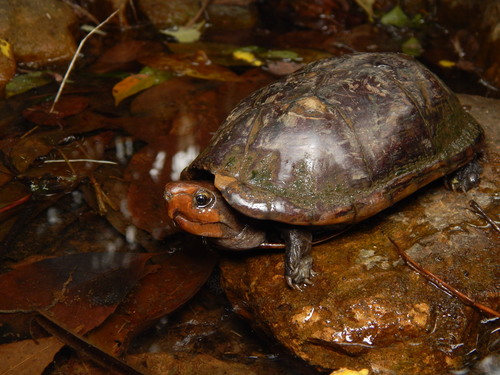
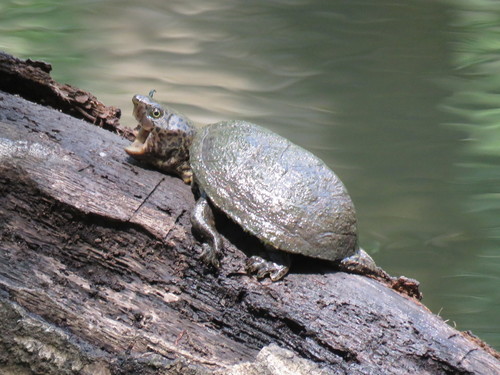
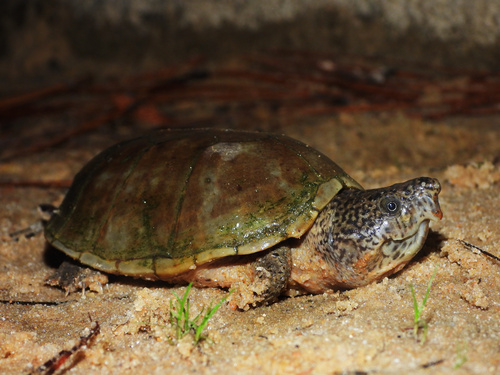
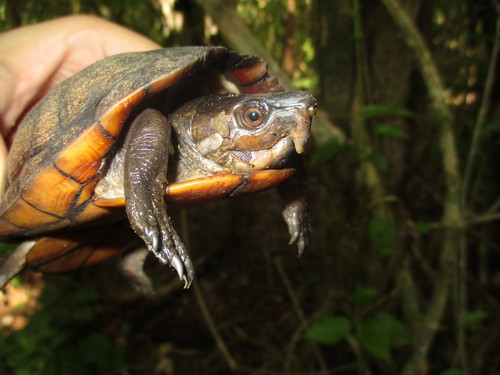
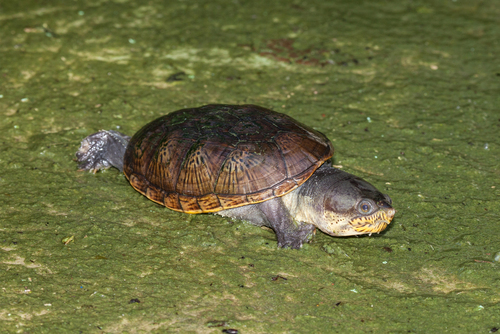
The narrow-bridged musk turtle (Claudius angustatus Cope, 1865) is typically brown in color. The scutes covering its upper shell (carapace) have natural lines and graining, giving the shell an almost wood-like look. It often has bright-yellow markings along the edges of its carapace.
Shell Algae Growth
As the turtle ages, algae often grow heavily over its shell, hiding the underlying patterning and original coloration.
Head and Neck Morphology
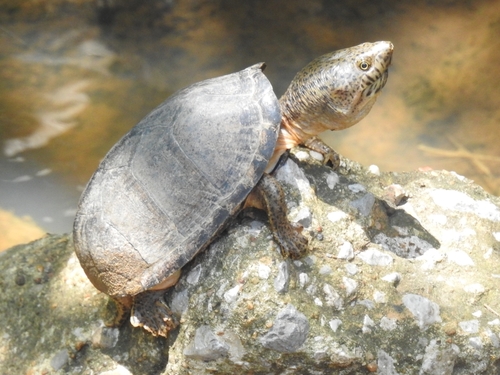
Relative to its body size, this turtle has a large, bulbous head, a sharp beak, and a long neck.
Jaw Joint Uniqueness
The jaw joint anatomy of the narrow-bridged musk turtle is unique among living Cryptodira. In most cryptodires, the jaw joint is formed by a biconcave facet. In the narrow-bridged musk turtle, the jaw joint is formed by a broad hemispherical condyle, a structure that is more similar to the jaw joints of Pleurodira.
Carapace Structure
The carapace of this turtle is domed, with three distinct ridges running along its full length.
Size
Although the narrow-bridged musk turtle is classified in the subfamily Staurotypinae alongside 'giant' musk turtles, it generally only grows to a straight carapace length of about 6.5 inches (16.5 cm).
Sex Determination
Unlike most turtle species, the narrow-bridged musk turtle uses genetic sex determination. While the exact mechanism has not been confirmed, it is suspected to follow an XX/XY system, just like its close relative Staurotypus.
Geographic Range
Claudius angustatus is found in Mexico, Guatemala, and Belize.
Habitat Preferences
Like all other musk turtles, the narrow-bridged musk turtle is almost entirely aquatic. It prefers habitats such as slow-moving creeks, or heavily vegetated shallow ponds.
Diet and Foraging
It spends most of its time walking along the bottom of these water bodies, foraging for aquatic insects, other invertebrates, and carrion.
Etymology of Common Name
It has scent glands under the rear of its shell that can release a foul-smelling musk, which is how it earned its common name.