About Sternotherus carinatus (Gray, 1856)
Carapace Size
The razor-backed musk turtle (Sternotherus carinatus) grows to a straight carapace length of about 15 cm (5.9 in).
Carapace Markings
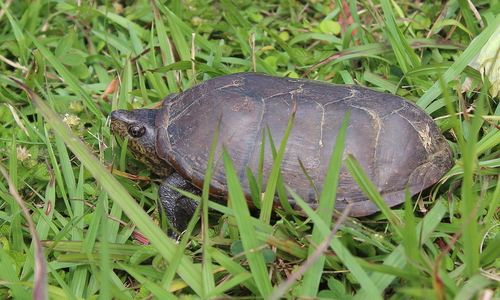
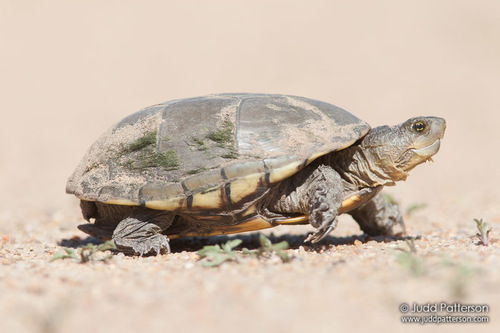
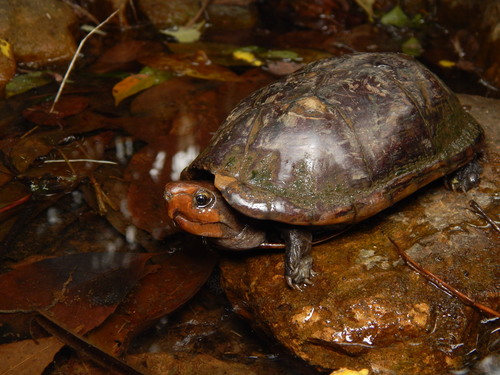
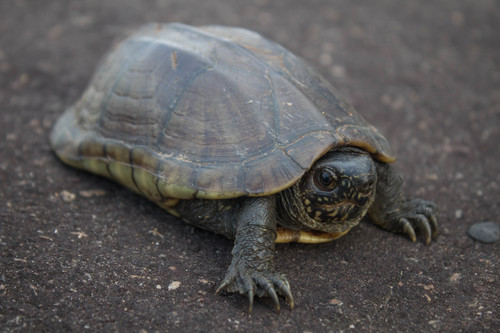
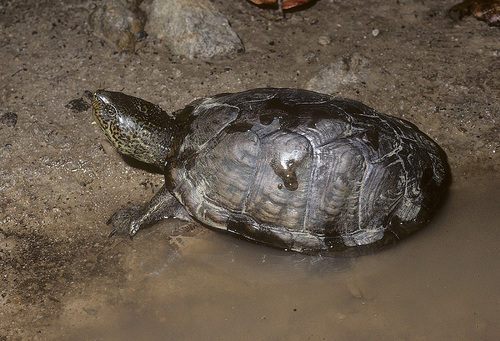
It has a brown carapace with black markings along the edge of each scute.
Carapace Keel
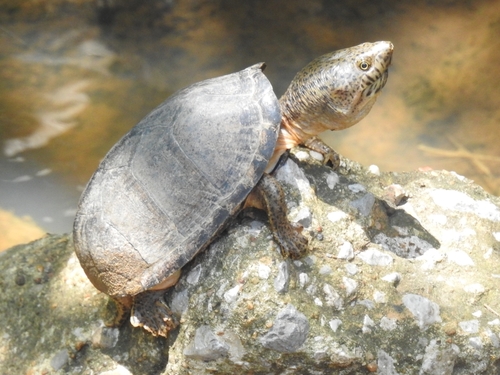
A distinct, sharp keel runs down the center of the carapace along its entire length, which gives the species its common name.
Body and Head Coloration
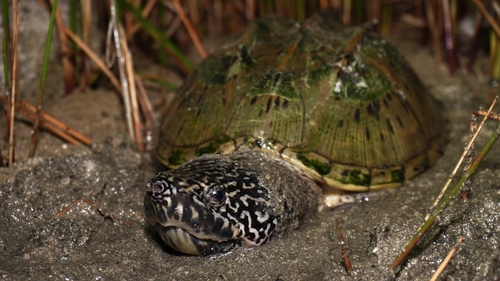
The body and head are typically grey-brown with black spotting, and the head usually has a bulbous shape.
Limb and Neck Features
The razor-backed musk turtle has a long neck, short legs, and a sharp beak.
Sexual Dimorphism
Males can usually be distinguished from females by their longer tails.
Plastron Characteristics
The plastron is small, with only one anteriorly located hinge, there is no gular scute, and barbels are only present on the chin.
Scent Defense
As the common name 'musk turtle' suggests, this species produces a scent from musk glands as a defense mechanism.
Scent Production Variation
However, the razor-backed musk turtle is known to produce much less of this scent, particularly captive individuals.
General Distribution
S. carinatus occurs across parts of the U.S. states of Alabama, Arkansas, Louisiana, Mississippi, Oklahoma, Florida, and Texas.
State-Specific Distribution
It is found throughout Louisiana, but only occupies limited regions of the other seven states: specifically southeastern Oklahoma, southern and eastern Texas, southern Arkansas, south-central Mississippi, and extreme southwestern Alabama.
Sexual Maturity Age
In terms of reproduction, female razor-backed musk turtles usually reach sexual maturity at four to five years of age, while males reach maturity at five to six years.
Captive Breeding Timing
In captive populations, mating takes place in March, and egg laying occurs in early May to early June.
Captive Clutch Details
Females lay approximately one to two clutches of eggs per year, with 5 to 7 eggs in each clutch for captive turtles.
Wild Clutch Details
Wild razor-backed musk turtles lay around 2 eggs per clutch.