About Cirsium occidentale (Nutt.) Jeps.
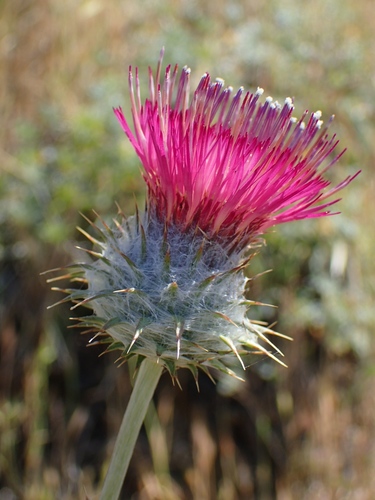
Cirsium occidentale is a biennial or perennial plant that grows a taproot. It can be short or quite tall, forming low clumps or reaching heights close to 3 meters (10 feet). Its leaves range from dull gray-green to bright white due to a coating of hairs. The largest basal leaves on mature plants can be nearly 0.5 meters (1 1/2 feet) long. Leaf petioles are winged and spiny, and leaves are toothed or edged with triangular lobes. The inflorescence at the top of the whitish stem holds one to several flower heads. Each head is roughly sphere-shaped, covered in large phyllaries that bear very long, spreading spines. These spines are often heavily laced with fibers that look like cobwebs. Each flower head is packed with disc florets, which may be white, blood red, or any of various shades of purple. The largest flower heads are more than 8 centimeters (3 inches) in diameter. Flower heads do not all open at the same time, which likely increases the chance of successful pollination. This plant is widespread and fairly common across most of California, growing in California's mountain ranges, valleys, and the Mojave Desert. It also occurs in the western Great Basin region, including western Nevada, southern Oregon, and southwestern Idaho. Unlike many introduced thistles, this native species is not a troublesome weed. Cirsium occidentale acts as a larval host for three butterfly species: the California crescent, mylitta crescent, and painted lady.