About Colaptes auratus (Linnaeus, 1758)
Taxonomic Introduction
This is the description of the northern flicker, Colaptes auratus (Linnaeus, 1758).
Adult Dorsal Coloration
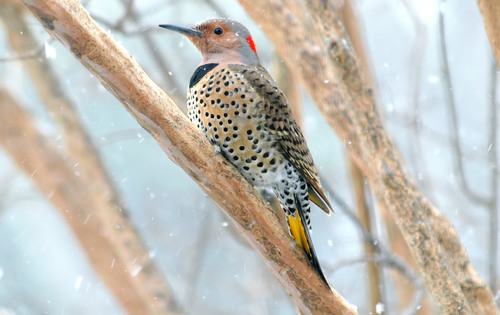
Adults are brown with black bars across their back and wings.
Overall Body Size
This mid- to large-sized woodpecker measures 28–36 cm (11–14 in) in total length, with a wingspan of 42–54 cm (16+1⁄2–21+1⁄2 in).
Body Mass Range
Body mass ranges from 86 to 167 g (3 to 5+7⁄8 oz).
Standard Morphometric Measurements
Standard scientific measurements for the species are: the wing bone measures 12.2–17.1 cm (4+13⁄16–6+3⁄4 in), the tail measures 7.5–11.5 cm (3–4+1⁄2 in), the bill measures 2.2–4.3 cm (7⁄8–1+11⁄16 in), and the tarsus measures 2.2–3.1 cm (7⁄8–1+1⁄4 in).
Size Variation By Range
The largest-bodied specimens come from the northern stretches of the species' range, at the latitude of Alaska and Labrador, while the smallest specimens come from Grand Cayman.
Upper Breast Markings
A black, necklace-like patch is present on the upper breast.
Underpart Coloration
The lower breast and belly are beige, marked with black spots.
Male Facial Markings
Males can be distinguished by a mustachial stripe at the base of the beak: this stripe is black in the eastern part of the species' range, and red in the western part.
Female Facial Markings
Females do not have this mustachial stripe.
Tail And Rump Features
The top of the tail is dark, transitioning to a conspicuous white rump that is visible when the bird is in flight.
Plumage Variation
Plumage varies between different subspecies.
General Habitat Range
Northern flickers can be found in open habitats near trees, including woodlands, forest edges, yards, and parks.
Western Mountain Habitat
In the western United States, they can be found in mountain forests all the way up to the tree line.
Typical Nesting Location
Like other woodpeckers, northern flickers generally nest in holes in trees.
Alternative Nesting Burrows
Occasionally, they have been recorded nesting in old earthen burrows that were vacated by belted kingfishers (Megaceryle alcyon) or sand martins (Riparia riparia).
Nest Excavation Participation
Both sexes help excavate the nest.
Nest Cavity Dimensions
The nest entrance hole is about 8 cm (3 in) in diameter, and the nesting cavity is 33–41 cm (13–16 in) deep.
Cavity Interior Structure
The cavity widens at the bottom to create space for eggs and the incubating adult.
Cavity Nesting Material
The inside of the cavity is almost entirely bare, with only a bed of wood chips for eggs and chicks to rest on.
Nestling Development Behavior
Once nestlings reach around 17 days old, they begin clinging to the cavity wall instead of lying on the cavity floor.
Human Structure Nesting
Northern flickers can also create cavities inside human homes, particularly homes with stucco or weak wooden siding.
Breeding Geographic Range
The breeding range of the northern flicker covers forested areas across North America, extending south as far as Central America.
Alternative Nesting Structures
This species is a cavity nester that typically nests in trees, but it may also use appropriately sized and sited posts and birdhouses.
Nest Reuse Behavior
It prefers to excavate its own nesting cavity, though it may reuse and repair damaged or abandoned nests.
Reused Nest Sources
These reused old nests are often created by belted kingfishers or sand martins.
Cavity Ecological Role
Abandoned northern flicker nesting cavities provide habitat for other cavity-nesting species.
Nest Displacement Risks
Sometimes, other cavity-nesting birds such as the common starling (Sturnus vulgaris) will displace northern flickers from their nesting sites.
Breeding Season Timing
Northern flickers usually breed between February and July, with timing depending on the temperature of the local area.
Breeding Pair Bond Duration
During the breeding season, mated pairs stay together; they do not remain paired after the breeding season ends.
Nest Construction Timeline
Before the breeding season starts, a mated pair needs one to two weeks to build their nest.
Male Courtship Displays
Males attract females through head bobbing behavior and specialized mating calls.
Pair Bond Call Use
A common call males use toward females is a repeated woikawoikawoika sequence, which signals their pair bond to both their mate and other birds.
Territorial Call Use
When this call is given toward another male, it acts as a territorial signal.
Call Acoustic Structure
This call pattern is flat at the start, and gradually rises into a loud noise.
Call Sound Components
The call itself is a chirp that includes drumming and rattling.
Male-Male Territorial Displays
Additional territorial displays toward other males include head swinging when near another male, and repeatedly striking objects with the beak to create loud noise.
Drumming Surface Preference
Males often use wood or metal to produce a louder sound.
Visual Territorial Displays
While producing these loud noises, males will spread their wings, move them up and down, and spread their tail to display their colorful underside.
Feather Color Function
Feather color varies based on the surrounding environment; there is currently no confirmed link between feather color and mate choice, and feather color plays a larger role in territorial signaling.
Additional Territorial Behavior
Northern flickers may also point their bill forward toward a competitor as a territorial display.
Nestling Predation Vulnerability
Juvenile northern flickers are often defenseless against predators that enter the nest.
Nestling Predator Species
Common predators of juveniles include Cooper's hawks (Astur cooperii), sharp-shinned hawks (Accipiter striatus), common raccoons (Procyon lotor), squirrels, and snakes.
Adult Predators
Full-grown northern flickers are preyed on by larger birds and hunting birds.
Nest Entrance Characteristics
The entrance hole of a northern flicker nest is roughly 5 to 10 cm (2.0 to 3.9 in) wide, and most often faces east to southeast.
Clutch Frequency
On average, northern flickers produce one to two clutches per breeding season.
Clutch Size
A typical clutch holds six to eight eggs.
Egg Appearance
The eggs are pure white, with a smooth, highly glossy shell.
Egg Size Comparison
Northern flicker eggs are the second-largest of any North American woodpecker species; only the pileated woodpecker has larger eggs.
Incubation Period And Participation
Both sexes incubate the eggs over a period of around 11 to 12 days.
Incubation Schedule
Usually, the male incubates overnight, while both the male and female incubate during the day.
Chick Rearing And Fledging
The young are fed by regurgitation, and fledge around 25 to 28 days after hatching.