About Chloropicus namaquus (A.A.H.Lichtenstein, 1793)
Nomenclature and Size
The bearded woodpecker (scientific name Chloropicus namaquus (A.A.H.Lichtenstein, 1793)) is one of the largest woodpecker species native to Africa, reaching an adult length of approximately 25 cm (10 in).
Head Pattern
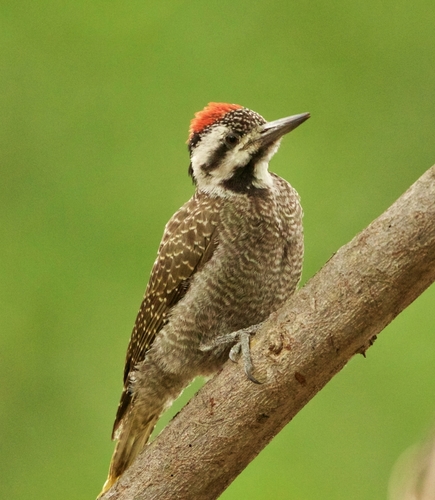
It has a distinctive head pattern: a black moustache, a broad black eye-stripe, and a black crown, which contrast with a white supercilium, white face, white chin, and white throat.
Sexual Dimorphism
The male has a red hind crown that is absent in the female.
Upper Body Plumage
Its mantle is black, and the rest of the upper body is yellowish-brown with narrow white barring.
Tail Morphology
The tail is brown with white barring, and its tail feathers have yellowish shafts.
Underpart Plumage
The underparts are grey with narrow white barring.
Beak and Soft Part Features
This species has a large greyish-black beak, grey legs, and red eyes.
Juvenile Features
Juvenile bearded woodpeckers resemble adults, but their upper parts have a greenish tinge and more diffuse barring, and both sexes have some red coloring on the crown and nape.
Geographic Range
This woodpecker is found in Angola, Botswana, Central African Republic, Chad, Democratic Republic of the Congo, Eswatini, Ethiopia, Kenya, Malawi, Mozambique, Namibia, Rwanda, Somalia, South Africa, Sudan, Tanzania, Uganda, Zambia, and Zimbabwe.
Habitat Types
It occupies a wide range of habitat types, including woodland with large trees, Brachystegia woodland, Euphorbia and Acacia woodland, gallery forest fringes, and brushland.
Altitudinal Range
It occurs from lowlands up to altitudes of approximately 3,000 m (10,000 ft).
Foraging Group Behavior
Bearded woodpeckers often forage in pairs, where members communicate vocally and flick their wings while calling.
Foraging Technique
Each individual spends a long time on a single tree, hammering, probing, and pecking with its beak to glean any stray insects it finds, before flying to another often distant tree.
Diet Composition
Its diet includes insects and their larvae, spiders, caterpillars, and ants, and it has been recorded catching geckos and small lizards.
Drumming Behavior
This species often drums loudly on branches, finishing each drum-roll with four taps.
Nest Site Characteristics
It drills its nest hole in dead wood, up to 20 m (70 ft) above the ground.
Clutch Size
The average clutch size is three eggs.
Incubation Details
Both parents take part in incubation, which lasts thirteen days.
Chick Rearing
Both adults care for the chicks, which remain in the nest for around four weeks before fledging.