About Picoides arcticus (Swainson, 1832)
Scientific Nomenclature
This species has the scientific name Picoides arcticus (Swainson, 1832), commonly called the black-backed woodpecker.
Adult Plumage - Dorsal Parts
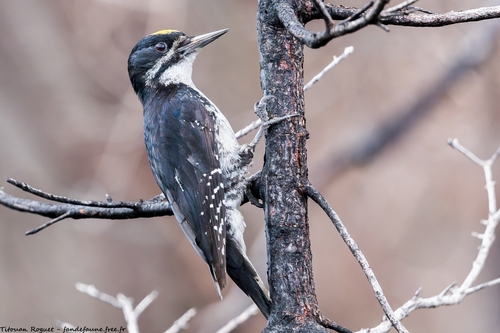
For adult plumage, the head, back, wings, and rump are black. Plumage from the throat through the belly is white, and the white flanks are marked with black bars. The tail is black, with white outer feathers.
Sexual Dimorphism
This species displays sexual dimorphism in plumage: adult males have a yellow cap.
Foot Morphology
Unlike nearly all other true woodpeckers, this species has three-toed feet; this trait is only shared with the related American three-toed woodpecker and Eurasian three-toed woodpecker.
Standard Measurements
Standard measurements for the species are: length 9.1 inches (23 cm), weight 2.1–3.1 oz (60–88 g), and wingspan 15.8–16.5 inches (40–42 cm).
Breeding Range
Its breeding range covers boreal forest across Canada, Alaska, the Northwestern United States, plus northern Wisconsin, the Adirondacks in New York, New England, Minnesota, and Upper Michigan.
Habitat Specialization
This species is a specialized burnt-forest bird that feeds on outbreaks of wood-boring beetles that develop in recently burnt trees.
Diet Composition
The main types of wood-boring beetles it eats are from the Cerambycidae and Buprestidae families; it also consumes engraver beetles and the mountain pine beetle.
Foraging Behavior
Most of its food is gathered by pecking, while a smaller portion is collected by gleaning food from branches.
Movement Patterns
Black-backed woodpeckers are generally non-migratory, but have historically carried out intermittent irruptions.
Nest Excavation Timing
Nest excavation happens in April and May.
Nest Construction
The species drills a new nest each year into the sapwood of dead trees. Abandoned nests of this species are used by other bird species for nesting.
Clutch Size
Females lay three or four eggs.
Incubation Behavior
Both parents share incubation duties, though only the male incubates overnight.
Chick Development
After hatching, the altricial chicks are brooded until they reach the nestling phase. Both parents feed the chicks, which fledge approximately 24 days after hatching.