About Chiloglottis cornuta Hook.f.
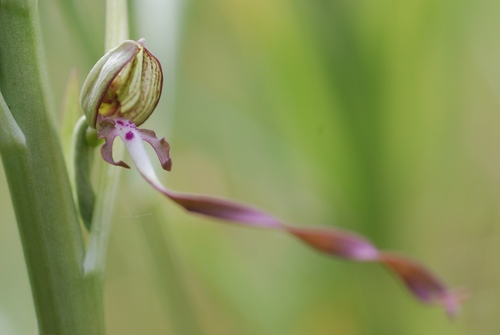
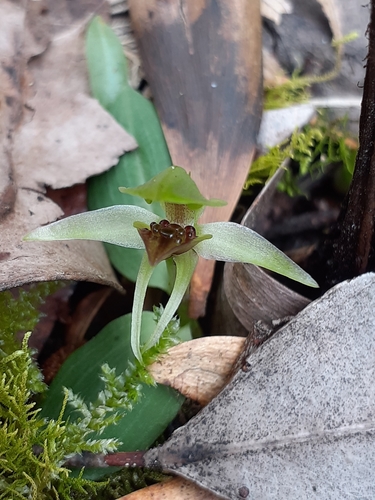
Chiloglottis cornuta, commonly known as the green bird orchid, is a terrestrial, perennial, deciduous herb. It produces two elliptic leaves, each 60–100 mm (2–4 in) long and 20–30 mm (0.8–1 in) wide, borne on a petiole 5–10 mm (0.2–0.4 in) long. A single green to reddish flower, measuring 13–16 mm (0.5–0.6 in) long and 25–30 mm (0.98–1.2 in) wide, is carried on a flowering stem 40–100 mm (2–4 in) high. The dorsal sepal is lance-shaped to egg-shaped, 13–16 mm (0.5–0.6 in) long and 5–7 mm (0.2–0.3 in) wide. Lateral sepals are 10–12 mm (0.4–0.5 in) long, about 3 mm (0.1 in) wide, and curve forwards. All sepals have a glandular tip around 1 mm (0.04 in) long. The petals are linear to lance-shaped, 10–12 mm (0.4–0.5 in) long, about 3.5 mm (0.1 in) wide, and spread widely apart from one another. The labellum is heart-shaped, 9–12 mm (0.4–0.5 in) long and 7–8 mm (0.28–0.31 in) wide, and bears six to eight rounded calli that can be dark red, green, reddish, or blackish. The column is erect, almost as long as the dorsal sepal, and has broad wings on its upper half. Flowering takes place from November to February. This orchid grows in moist, sheltered forest habitats. In Australia, it is found in far south-eastern New South Wales, eastern Victoria, far south-eastern South Australia, and Tasmania. In New Zealand, it occurs on the North Island, South Island, Stewart Island, Chatham Island, the Antipodes Islands, Campbell Island, and Auckland Island.