About Rhynchostylis retusa (L.) Blume
Rhynchostylis retusa (L.) Blume, also commonly known as the foxtail orchid, is an orchid that belongs to the Vanda alliance.
Inflorescence Features
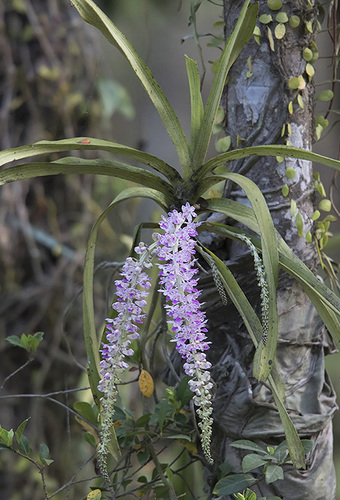
Its inflorescence takes the form of a pendant raceme, and holds more than 100 pink-spotted white flowers.
Stem and Leaf Characteristics
This species has a short, stout, creeping stem that bears up to 12 curved, fleshy leaves; the leaves are deeply channeled, keeled, and have retuse apices.
Blooming Traits
It blooms from winter to early spring, producing an axillary pendant cylindrical inflorescence that can reach 60 cm (24 in) in length, and is densely covered in flowers.
Growth Habitat
This plant is an epiphyte that grows on tree trunks in open forests or at forest margins, at elevations between 300 and 1,500 m (980 to 4,920 ft).
Global Distribution
It is naturally distributed across Bhutan, Cambodia, China (specifically Guizhou and Yunnan), India, Indonesia, Laos, Malaysia, Myanmar, Nepal, the Philippines, Singapore, Sri Lanka, Thailand, and Vietnam.
Regional Distribution in India
In India, it is most common in the Northeast region, Odisha, and Andhra Pradesh; in Andhra Pradesh, it is known by the Telugu name Chintaranamu.
Conservation Status
Due to bio-piracy, the species is on the verge of extinction in India.
Official Symbol Status
It is officially recognized as the state flower of Arunachal Pradesh and Assam in India, and also as the provincial flower of Uva Province in Sri Lanka.
Historical Medicinal Uses in Malabar
Historically, various preparations of this plant have been used for medicinal purposes in Malabar District to treat asthma, tuberculosis, nervous twitchings (which may correspond to tic disorder), cramp, epileptic spasms, vertigo, palpitations, kidney stones, and menstrual disorders.
Medicinal Uses in Assam
In Assam, the plant has also been used to treat wounds, cuts, and bruises.
Emollient Use
It has been used as an emollient across India and Nepal.
Rheumatism Treatment Use
Across the entire Indian subcontinent, the root of this plant is used under the name rasna to treat rheumatism.