About Cheilio inermis (Forsskål, 1775)
Species Nomenclature
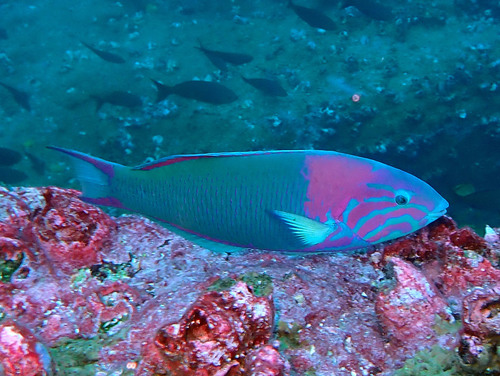
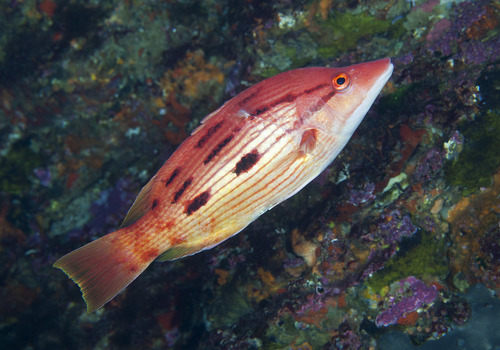
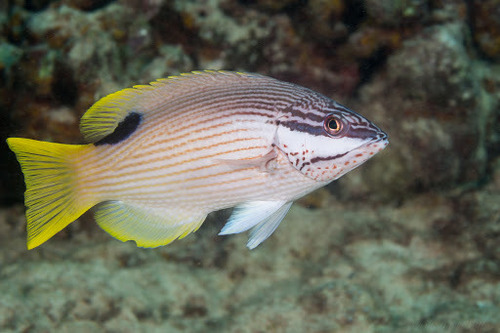
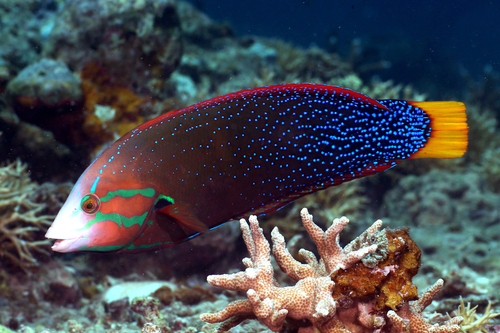
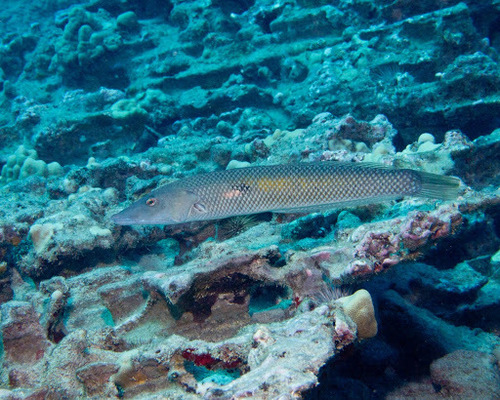
Cheilio inermis (Forsskål, 1775), commonly called the cigar wrasse, grows to an average length of 35 cm (14 in) and can reach a maximum length of 50 cm (20 in).
Juvenile Coloration
Young individuals are typically mottled brown or green, and sometimes have a broad lateral stripe. Rare individuals may be solid yellow in color.
Male Coloration
Large males may develop a bright yellow, orange, black, white, or multicolored patch on their sides, behind their pectoral fins.
Aquarium Suitability
Due to their adult size and diet, cigar wrasses are rarely kept in aquariums.
Geographic Range
The cigar wrasse is native to the Indian and Pacific Oceans.
Primary Habitat
Its primary habitat is seagrass in shallow reef areas, and it has a strong affinity for staying in habitats surrounding seagrass, which provides both protection from predators and nutrition.
Seagrass Bed Occurrence
Both adults and juveniles are abundant in seagrass beds year-round, and they also occur in large numbers feeding in canopy macroalgae habitats, and along the perimeter of their primary seagrass habitat where they feed and hide.
Alternative Habitats
They can also be found in soft coral reefs near sandy seagrass beds, and in other habitats close to the seagrass beds they regularly use.
Feeding Seasonality
Cigar wrasses feed primarily during the summer, but stay in the same algae meadows throughout the winter.
Depth Range Uncertainty
It is unknown if cigar wrasses differ from other wrasse species that have been recorded at a depth of 10 meters.
Shallow Habitat Use
Like other wrasses, cigar wrasses generally occupy shallow areas such as reefs and algae meadows, and are normally observed close to shore in large groups.
Home Range Behavior
Wrasses are relatively stationary fish that stay within a home range for their entire lives; for the cigar wrasse, this means individuals do not stray far from the seagrass bed where they hatched.
Wrasse Cleaner Fish Behavior
Many wrasse species act as cleaner fish, eating fish lice and other parasites off larger fish.
Aquaculture Cleaner Fish Use
Fisheries use wrasses to remove parasites from salmon and trout, and an estimated 1.4 million parasites were removed via this method at a single Norwegian fishery between 2009 and 2010.
Cigar Wrasse Cleaner Behavior Uncertainty
Wrasses are commonly used for this purpose by salmon fisheries around the world, but it remains unknown whether cigar wrasses naturally display this cleaner fish behavior in the wild.
Wrasse Collection for Fisheries
Because wrasses have stationary behavior, large numbers can be easily collected for use by fisheries.
Wrasse Conservation Threat
This collection is a major threat to many wrasse species, as far more wrasses are caught for use in salmon farms than are caught as fishing bycatch.