About Chaetodon speculum Cuvier, 1831
Nomenclature and Taxonomic Placement
The mirror butterflyfish, also called the oval-spot butterflyfish, has the scientific name Chaetodon speculum Cuvier, 1831, and is a species of butterflyfish in the family Chaetodontidae.
Distribution Range
This species is distributed across the Indo-Pacific, ranging from Indonesia to Japan, and south to the Great Barrier Reef and Papua New Guinea; it has also been recorded from Madagascar, Mauritius, and Réunion.
Maximum Length
It reaches a maximum length of 18 cm (7 in).
Fin Structure
Its dorsal fin has 14 spines and 17 to 18 soft rays, while its anal fin has 3 spines and 15 to 16 soft rays.
Coloration and Markings
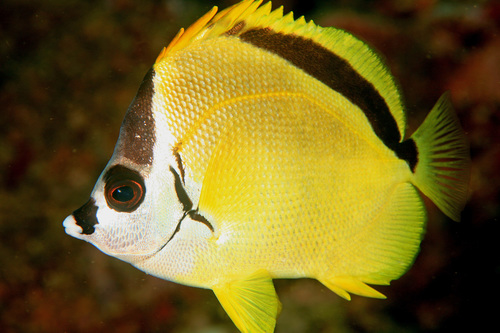
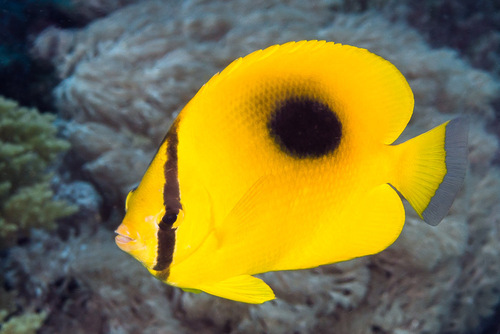
Its body ranges from bright to orange-yellow, with a large black blotch below the dorsal fin and a vertical black bar that runs through the eye.
Formal Description
Chaetodon speculum was first formally described in 1831 by French anatomist Georges Cuvier (1769–1832), with its type locality given as Jakarta.
Subgenus Classification
Along with other butterflyfish that have angular yellow bodies, black eyestripes, and a single differently colored patch—an exception being the relatively basal blue-lashed butterflyfish, C. bennetti—it is classified in the subgenus Tetrachaetodon.
Closely Related Species
Within this group, it appears to be particularly closely related to the Zanzibar butterflyfish (Chaetodon zanzibarensis), which has a smaller black blotch and faint horizontal stripes on its flanks.
Potential Generic Reclassification
If the genus Chaetodon is split into separate genera, the subgenus Tetrachaetodon would be placed in the genus Megaprotodon.
Habitat Depth
The mirror butterflyfish inhabits coral reefs at depths of 3 to 30 meters.
Preferred Habitat Features
It prefers coastal reef slopes that have abundant hydroids and sea anemones.
Juvenile Behavior
Small juvenile individuals hide within coral thickets.
Social Behavior and Abundance
This species is typically solitary, and it is relatively uncommon.
Diet
It feeds on coral polyps and invertebrates.