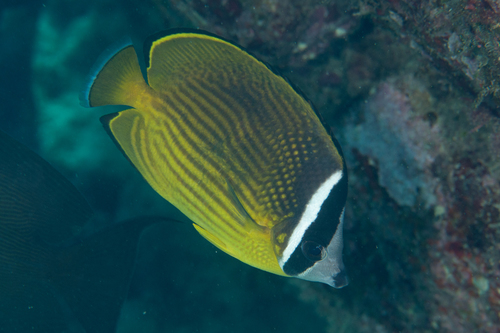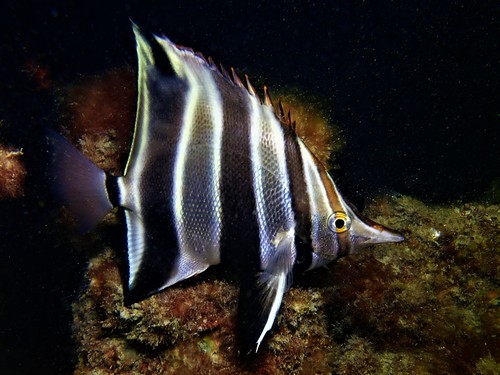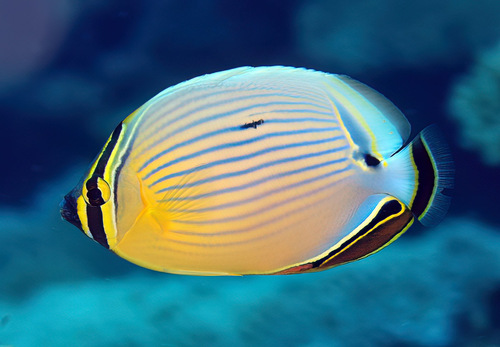
About Chaetodon lunulatus Quoy & Gaimard, 1825
Common Name and Similar Species
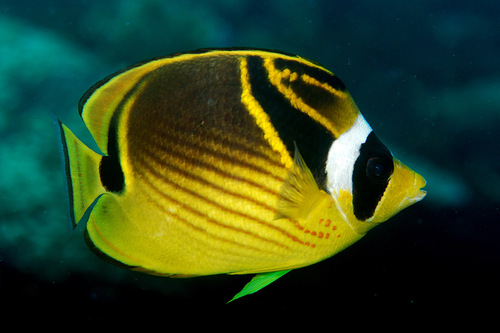
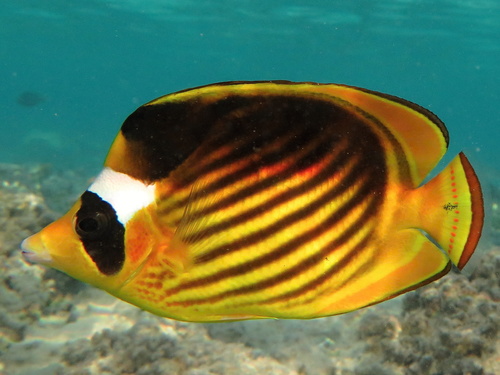
Chaetodon lunulatus, commonly called the oval butterflyfish, has similar coloration to the blacktail butterflyfish (C. austriacus) and the melon butterflyfish (C. trifasciatus).
Coloration Distinctions from Related Species
The blacktail butterflyfish has black caudal and anal fins, while the melon butterflyfish is an Indian Ocean species that has a more conspicuous dark patch below its dorsal fin and a mostly yellow anal fin.
Maximum Length
Chaetodon lunulatus can reach a maximum length of 14 cm.
Fin Structure
It has approximately 13 to 14 dorsal spines, 20 to 22 dorsal soft rays, three anal spines, and 18 to 21 anal soft rays.
Subgenus Classification
Along with the blacktail and melon butterflyfishes, and likely the unusual Arabian butterflyfish (C. melapterus), C. lunulatus forms the subgenus Corallochaetodon.
Related Subgenus
This subgenus is probably closely related to the subgenus "Citharoedus" — a name that is a junior homonym of a mollusc genus — which contains the scrawled butterflyfish (C. meyeri).
Potential Genus Reclassification
If the genus Chaetodon is ever split into separate genera, the Corallochaetodon group would likely be separated into the genus Megaprotodon, along with the Citharoedus group.
Geographical Distribution
The oval butterflyfish is distributed across the Pacific Ocean, ranging north to Japan, south to Australia, and east to Hawaii and the Tuamotu Islands.
Habitat and Depth Range
It is a benthopelagic tropical species that inhabits coral reefs, found at depths between 3 and 30 meters in coral-rich lagoons and semi-protected seaward reefs.
Juvenile Behavior
Small juvenile oval butterflyfish are secretive and hide within corals.
Reproduction and Sexual Dimorphism
The oval butterflyfish is oviparous and shows very little sexual dimorphism.
Social Structure
Individuals of this species may live either solitarily or in pairs.
Pair Composition
Research shows that most pairs are heterosexual, an arrangement that most likely developed to ease reproduction.
Partner Fidelity
Partner fidelity is often long-term; one study recorded pairs staying together for up to seven years.
Sex-Based Pair Roles
In established pairs, females feed more often, while males tend to lead when the pair swims in tandem.
Pair Swimming Behavior
Pairs regularly swim parallel to each other in close proximity, usually staying within 1.5 meters of each other, and almost never move more than 4 meters apart.