About Chaetocercus heliodor (Bourcier, 1840)
Taxonomy and Naming
The gorgeted woodstar (scientific name Chaetocercus heliodor, first described by Bourcier in 1840) measures 5.8 to 6.4 cm (2.3 to 2.5 in) in length. It is the smallest species among woodstars, a group of birds that are collectively some of the smallest birds in the world.
Bill Characteristics
Both male and female gorgeted woodstars have a straight black bill.
Nominate Male Plumage
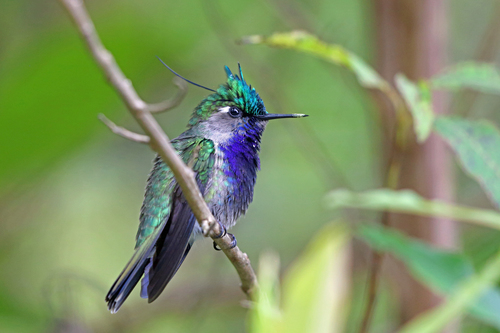
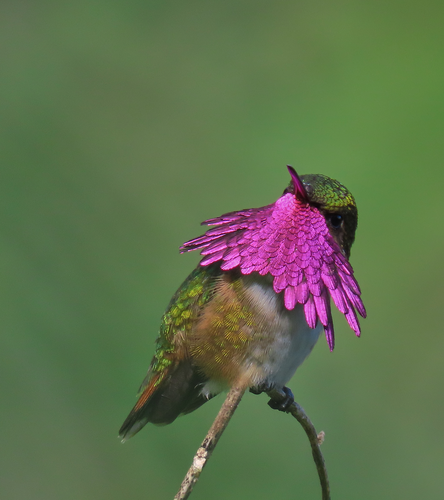
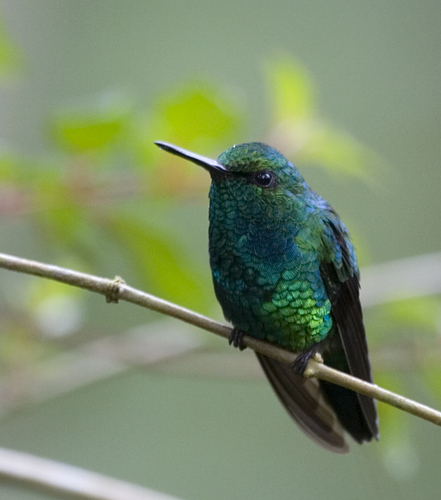
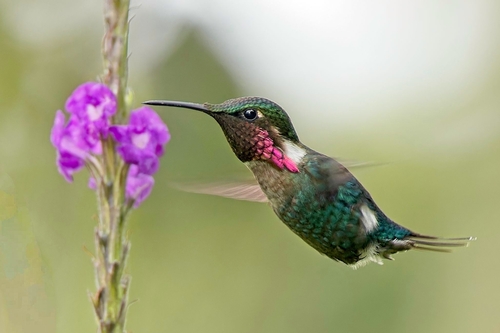
The male of the nominate subspecies is mostly dark metallic blue-green. It has a pinkish purple gorget that stretches across its neck, a grayish line behind the eye, a grayish breast, and white spots on the flanks.
Nominate Male Tail Structure
Its tail is forked, with very short central feathers and outer feathers that have bare shafts.
Nominate Female Plumage
The upperparts of the nominate subspecies female are bronzy green with a rufous rump. Its underparts are cinnamon-rufous, and its rounded tail is cinnamon with a black bar near the tip.
C. h. cleavesi Male Characteristics
Males of the subspecies C. h. cleavesi are darker than the nominate males, with a less purple gorget and a shorter tail.
Nominate Subspecies Distribution
The nominate subspecies of gorgeted woodstar lives in the Andes, from Venezuela's Mérida state south through Colombia to western Ecuador.
C. h. cleavesi Distribution
C. h. cleavesi is found in the Andes of northeastern Ecuador, between the provinces of Sucumbíos and Morona-Santiago.
Habitat Types
This species lives in semi-open to open landscapes, including humid forest edges, coffee plantations, and areas with scattered trees and shrubs. It occasionally visits the lower sections of páramo.
Elevation Range
Its elevation range is between 1,200 and 3,000 m (3,900 and 9,800 ft).