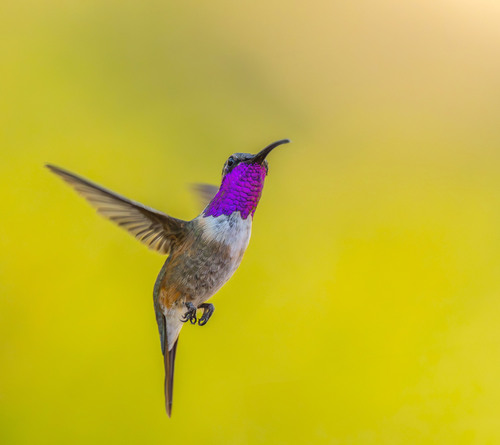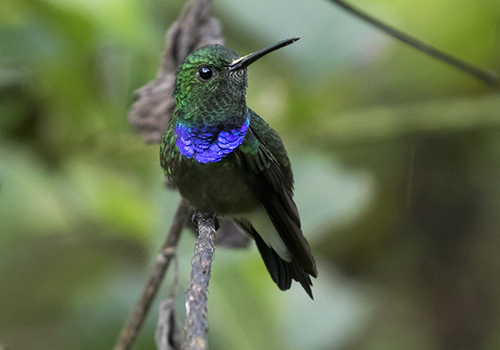
About Cynanthus latirostris Swainson, 1827
Species and Taxonomy
The broad-billed hummingbird (Cynanthus latirostris Swainson, 1827) is a small hummingbird, measuring around 8–10 cm (3.1–3.9 in) in total length with an average wingspan of 13 cm (5.1 in).
Size and Weight
Individuals weigh 3–4 grams, with males being slightly heavier than females.
Bill Morphology
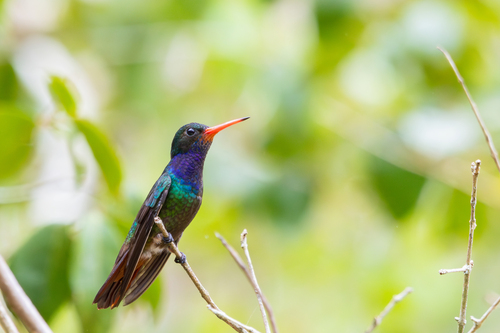
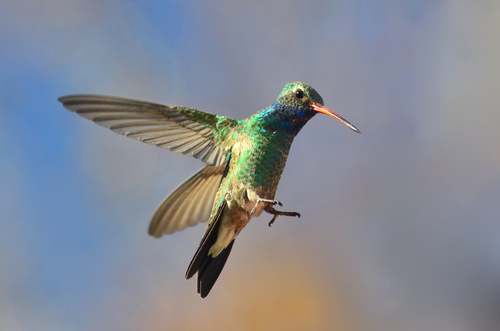
This species has a long, bright reddish bill that ends in a black tip.
Dorsal Coloration
Its dorsal side is metallic green, with duller coloration on the crown and forehead.
Sexual Dimorphism
Broad-billed hummingbirds are sexually dimorphic, meaning adult males and females differ significantly in appearance.
Adult Male Appearance
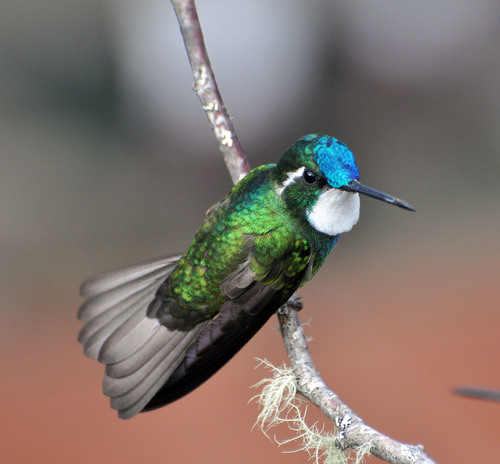
Adult males are dark green with white undertail-coverts, a blue throat, a broad blackish-blue tail, and brownish-gray flight feathers. Their bills are shorter but brighter red than those of females, and adult males have larger wings and tails than females.
Adult Female Appearance
Adult females have a pale belly, a white eyestripe behind the eye, and white-tipped tail feathers.
Juvenile Base Coloration
Juvenile coloration generally resembles that of adult females.
Juvenile Male Traits
Over time, juvenile males develop red bills and iridescent throat feathers, and unlike females, juvenile males do not have white-tipped tails. Like males of all age classes, juvenile males have larger wings and tails than females.
Hatchling Appearance
Newly hatched broad-billed hummingbirds have brown bodies, orange downy feathers, and orange bills.
Plumage Development
Little is known about wild hatchlings, but captive juvenile broad-billed hummingbirds grow full adult plumage within 6–8 months of hatching.
US Subspecies Habitat
In terms of distribution and habitat, the subspecies C. l. latirostris occurs in the United States, where it inhabits streamsides and oak woodlands. It prefers areas with streamside groves, dense vegetation, and open oak woodlands in lower canyons, and favors locations that contain Arizona sycamore (Platanus wrightii), Fremont cottonwoods (Populus fremontii), and mesquite.
Mexico Elevation Range
Across Mexico, specimens of this species have been collected at nearly all elevations, ranging from 1494 to 3048 meters above sea level.
Pacific Coast Habitat
Along Mexico's Pacific coast, the broad-billed hummingbird is a common year-round resident of arid thorn forests, tropical deciduous forests, and riparian gallery forests.
Breeding Season Habitat
During breeding season, the species is most common in desert canyons and low mountain oak woodlands.
Overall Geographic Range
The broad-billed hummingbird's overall range extends from the southwestern United States south to central Mexico.
Breeding Distribution
Breeding has been recorded in southeastern Arizona, southwestern New Mexico, and rarely in southwestern Texas.
Vagrant Sightings
Rare vagrant sightings have been recorded across the continent, including in Arkansas.
Sonora Population Status
In the Mexican state of Sonora, the broad-billed hummingbird is the most common hummingbird species.