About Chlorostilbon melanorhynchus Gould, 1860
Size and Weight
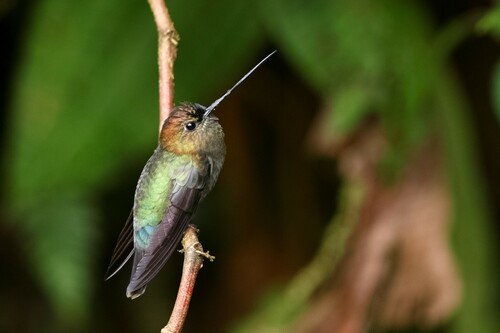
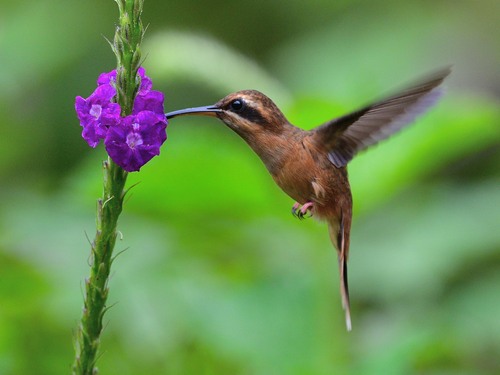
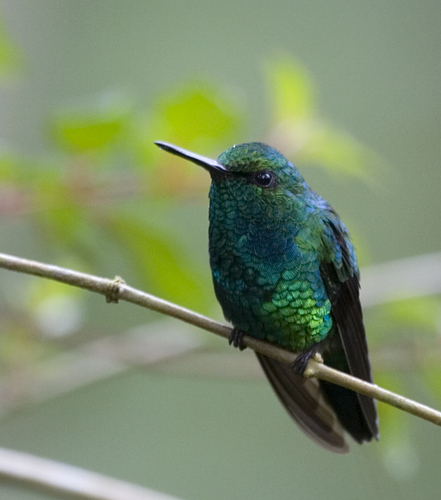
Chlorostilbon melanorhynchus, commonly called the western emerald, measures 10.9 to 11.4 cm (4.3 to 4.5 in) long and weighs approximately 2.6 g (0.092 oz). Both sexes of both recognized subspecies have a short black bill.
Nominate Male Plumage
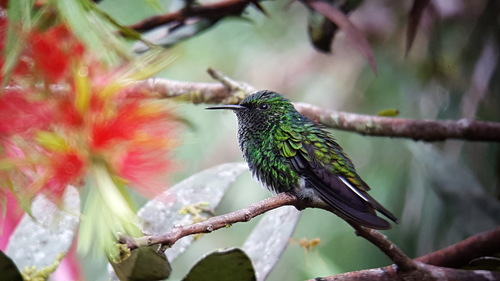
The nominate subspecies male has an iridescent green forehead and crown with gold highlights, a bright green face, shining bronzy green upperparts, and a steel blue tail. Its underparts are glittering emerald green, with greater iridescence and a blue tinge on the breast, and it has white thigh tufts.
Nominate Female Plumage
The nominate subspecies female has a bronzy green forehead and crown, a blackish face with a pale gray spot behind the eye, metallic grass green on the rest of its upperparts, and a blue-black tail with white tips. Its underparts are pale gray to white, with a buffy tone on the throat and belly.
C. m. pumilus Distinction
When treated as a separate subspecies, C. m. pumilus differs from the nominate only by having a slightly shorter bill and a brighter crown.
Overall Distribution
The western emerald is distributed from the Western Andes of Colombia south into Ecuador.
Nominate Subspecies Range
The nominate subspecies C. m. melanorhynchus occurs in the upper subtropical zone of Colombia and the temperate zone in Ecuador.
C. m. pumilus Habitat Zones
Subspecies C. m. pumilus is found at lower elevations, in arid and semi-arid tropical and subtropical zones.
Colombian Elevation Range
In Colombia, the species ranges between elevations of 1,000 and 2,000 m (3,300 and 6,600 ft).
Ecuadorian Elevation Range
In northwestern Ecuadoran valleys, it occurs between 1,500 and 2,700 m (4,900 and 8,900 ft), and mostly between 600 and 1,800 m (2,000 and 5,900 ft) elsewhere in Ecuador. It has been recorded as low as sea level and as high as 3,050 m (10,000 ft).
Habitat Preferences
The western emerald inhabits open to semi-open landscapes, including the edges and clearings of mature forest, plantations, cultivated areas, fields, and gardens.