About Ceodes brunoniana (Endl.) Skottsb.
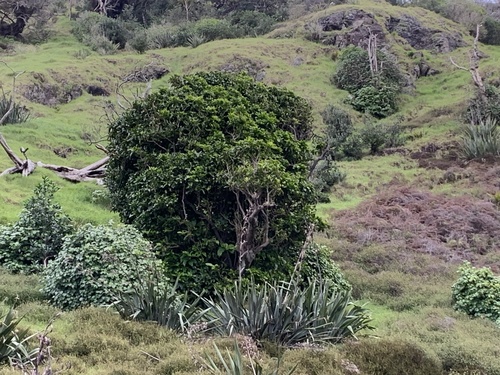
Ceodes brunoniana (Endl.) Skottsb. is a spreading small tree that reaches 6 metres (20 ft) or more in height. This species has soft wood and brittle branches. Its large leaves are either opposite or ternate, glabrous, glossy, entire (meaning simple with smooth margins), and obtuse to rounded at the apex. It produces paniculate, many-flowered inflorescences, and the individual flowers are unisexual. Its fruits are very sticky, narrowly ellipsoidal, 2–3 centimetres (0.79–1.18 in) long with five ribs, and small birds are often trapped in the sticky fruits. The sticky seeds of Pisonia grandis, a related species, regularly cause seabird deaths in the Seychelles, and research suggests these seeds evolved to attach to seabird plumage to be carried to distant islands, enabling long-distance species dispersal. This same situation may hold for Ceodes brunoniana, which was formerly referred to as P. brunoniana. In New Zealand, Ceodes brunoniana grows in coastal forest on Raoul Island in the Kermadec group, the Three Kings Islands, and in scattered locations in the North Island from Whangape Harbour to Mangawhai. Historically, the species grew near Auckland, on the Coromandel Peninsula, and at East Cape. Today it is mainly found on offshore islands, especially rodent-free islands, where it often forms an important understorey component of mixed-broadleaf forest. The species is almost extinct in the mainland North Island, in part because browsing animals such as possums, goats, and feral cattle eagerly eat its large leaves. Ceodes brunoniana is reasonably common in cultivation as a decorative tree in New Zealand, particularly in the northern North Island. Two variegated cultivars are sold as C. brunoniana in New Zealand nurseries, though one cultivar with leaves extensively marbled with white may actually be C. umbellifera, a similar species that occurs throughout the tropical Indo-Pacific.