About Cenarrhenes nitida Labill.
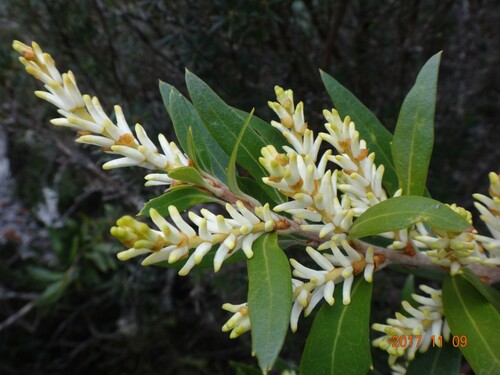
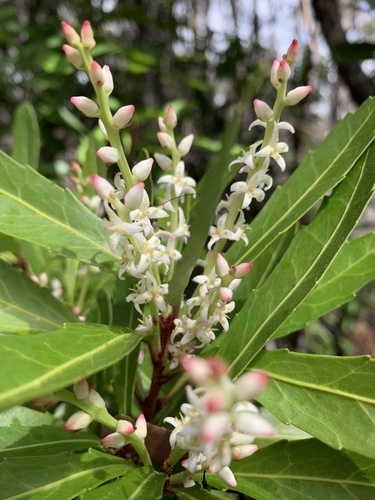
Cenarrhenes nitida grows as an erect shrub or small tree, reaching 10 meters tall in sheltered locations like rainforests, and only 2 meters tall in exposed sites. Its leaves are roughly 8 to 12 centimeters long, thick, dull, and hairless, with cleanly serrated edges and a rounded tip. Each leaf attaches to the stem via a short stalk, and leaves are spread along the branches. When crushed, the leaves give off a nauseating stale-cabbage smell, which helps distinguish this species from the similar-looking Anopterus glandulosus. A. glandulosus lacks this odor, typically has longer leaves, and its leaves are arranged in false whorls. Cenarrhenes nitida leaves turn black when dried. Flowers are produced in early summer, from November to December. They are small, symmetrical, unscented, and each has four pointed, fleshy petals that curl backward when the flower opens. Closed flowers have pink tips, and become entirely white when open. The stalkless flowers are arranged on woody spikes that are shorter than the leaves. Flowers are insect-pollinated, and have four thick, cream-yellow stamens. Pollination is spring-loaded, triggered by a touch-sensitive hair on one of the four anthers. Usually, only one to three flowers per spike stalk develop into mature fruit; the rest form stunted woody balls. The fruit of C. nitida is a fleshy drupe that closely resembles commercial plums from the genus Prunus, which gives the species its common name. Fruits are roughly 1.5 centimeters across, and can grow up to 3 centimeters. They have smooth, deep purple skin, edible but chalky-tasting pink-white flesh, and a large central stone. Like plums, the fruit has a groove running down one side, and a fine dusty coating on its skin that creates a bluish tint, which can be easily removed by rubbing. Fruits ripen in autumn, from March to May. Cenarrhenes nitida is endemic to southern and western Tasmania, including some of its islands. It grows at altitudes up to 800 meters, reaching the margins of the alpine zone. It occurs most often as an understory tree or small shrub in wet sclerophyll forests and rainforests with poor soil, and occasionally grows in heath, button grass sedgeland, and scrub. Offshore populations exist inland on South Bruny Island and in forested areas of the De Witt Islands, habitats that closely match environments on mainland Tasmania. Cenarrhenes nitida is a slow-growing plant that requires a cool, moist, shady site with well-composted soil and preferably good drainage. Seeds mature after the fruit flesh is removed and the stone is dried. Seeds can be stored this way if kept in a well-ventilated area. Germination is triggered by temperatures around 20 °C (68 °F), after at least two months of cold stratification. This species is often difficult to propagate, and grows very slowly if conditions are not suitable. It grows best from seed, as cuttings stay green for a long time without rooting before turning brown and dying.