About Grevillea dryophylla N.A.Wakef.
Species Nomenclature and Habit
Grevillea dryophylla, also known as Goldfields grevillea, is a spreading to erect shrub that typically grows 0.3–1.5 m (1 ft 0 in – 4 ft 11 in) tall, and has hairy branchlets.
Leaf Dimensions
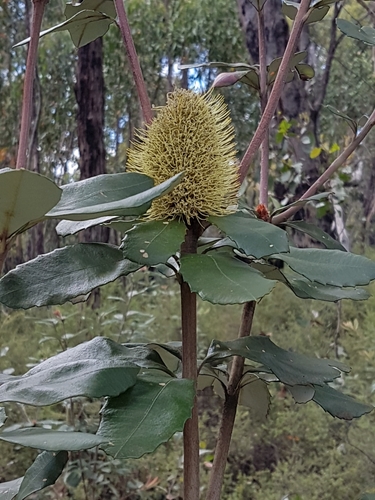
Its leaves are 20–85 mm (0.79–3.35 in) long and 20–70 mm (0.79–2.76 in) wide in outline.
Leaf Structure
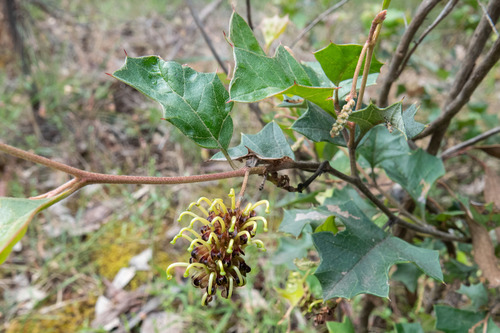
They usually have three to seven lobes that measure 6–30 mm (0.24–1.18 in) long and 5–20 mm (0.20–0.79 in) wide, though leaves are occasionally simple or have two to five teeth instead.
Leaf Surface and Margins
The tips of the teeth or lobes are usually sharply pointed, the leaf edges are curled downward, and the lower leaf surface is covered with wavy to curly hairs.
Inflorescence and Flower Color
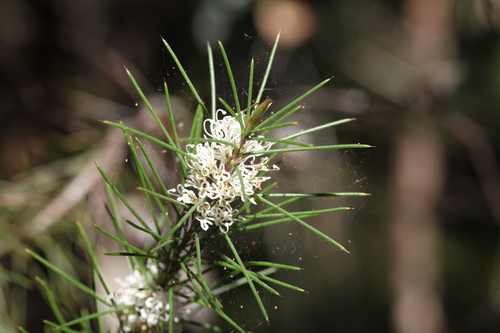
The flowers are arranged in groups on a 10–40 mm (0.39–1.57 in) long rachis, and are green to light brown or dull yellow.
Pistil and Style Characteristics
The pistil is 13.5–15.5 mm (0.53–0.61 in) long, with a glabrous red, pink, or dull yellow style.
Flowering Period and Fruit
Flowering occurs from August to November, and the fruit is a glabrous follicle with silky hairs that is 9–12.5 mm (0.35–0.49 in) long.
Habitat and Distribution
This grevillea is found in dry sclerophyll forest in the region bounded by St Arnaud, Bendigo, Castlemaine and Maryborough.