About Hakea leucoptera R.Br.
Growth Habit
Hakea leucoptera R.Br. is a plant with a highly variable growth habit. It can grow as a small, openly branched tree reaching up to 5 m (20 ft), or as a small multi-stemmed shrub growing up to 3 m (10 ft).
Soil Preference
It typically grows in coarse-textured soils, and is associated with a wide variety of species in woodland communities.
Distribution
It is widespread across all Australian mainland states, growing in dense shrub thickets, as scattered individual trees, or as a large parent tree surrounded by its offspring.
Timber Characteristics
Its timber is reddish-brown and close-grained; it is soft when fresh but becomes hard and brittle when dry.
Leaf Arrangement and Color
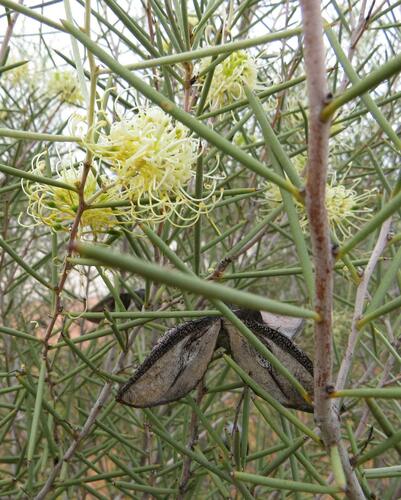
Its silvery grey to grey-blue leaves are arranged alternately along the stems.
Leaf Morphology
The leaves are rigid and cylindrical, ranging in length from 8–35 mm (0.3–1 in), and are approximately 1.5 mm (0.06 in) wide, ending in a sharp pointed tip.
Leaf Hair Coverage
Young leaves are covered in fine hoary hair, but become smooth as they mature.
Flower Structure
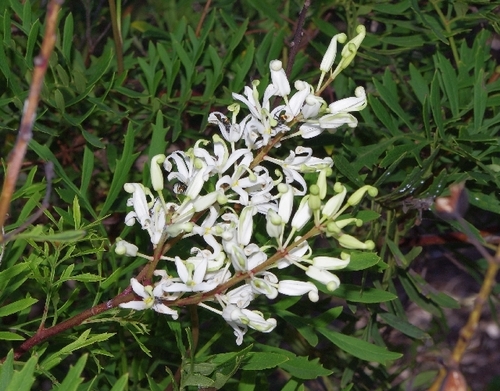
Showy creamy white flowers grow on short, hairless stalks about 4 mm (0.2 in) long, arranged in axillary raceme clusters of 20 or more flowers.
Flowering Period
Hakea leucoptera flowers from late spring to summer.
Fruit Shape
Its fruit is a woody follicle 20–30 mm (0.8–1 in) long, swollen at the base and tapering to a point.
Fruit and Seed Structure
The fruit capsules split open longitudinally into two halves, revealing two seeds that each have an opaque wing on only one side.
Seed Pod Retention
Woody seed pods can stay attached to the branches until after the following year’s flowering.
Seed Ripening
Immature seeds will not ripen if removed from the plant, so it is best to collect older mature fruits.
Fruit Crop Variability
Fruit crop size varies from year to year.
Fruit Drying Time
Once collected, fruits usually dry out and open within 1–2 weeks.
Propagation
The species is easily grown from fresh seed, which typically germinates in 3–6 weeks, and seed is suitable for direct seeding.
Native Range
Hakea leucoptera is found in every state of Australia except Tasmania, and is commonly recognized as a dry-country species native to arid and semi-arid regions.
Palatability to Livestock
Shrubby forms of the plant are palatable to livestock, but only during periods of severe feed shortage.
Pipe Making Use
Smoking pipes have been manufactured from its roots, and in 1895 the Australian Needle-wood Pipe Company was formed in Sydney for this purpose.
Traditional Water Extraction
This plant was important to Indigenous Australian people and inland explorers, who obtained water from its roots. To extract water, the tree was burnt to drive water into the root system, after which the roots were dug up, their outer bark stripped, one end held over a slow fire and the other end positioned over a container to force water out of the root.
Fire Regeneration
This ability to store water also lets the plant regenerate quickly after fire.
Nectar Uses
A sweet, nutritious drink can be made by dipping flower-laden branches into a cup of water, or by sucking nectar directly from the flowers.
Honey Production
Hakea leucoptera flowers produce high-quality honey favoured by bees.
Medicinal Uses
Indigenous people of inland Australia used corkwoods from this species as medicine. Burnt bark was applied directly to burns and open sores, or mixed with animal fat to create a healing ointment.
Decorative Uses
Indigenous people also used the plant's woody seed pods for decoration.
Additional Timber Uses
The plant's timber polishes well, has a very showy grain, and has also been used to make small tannery articles.