About Celeus elegans (P.L.S.Müller, 1776)
Taxonomic Naming
The chestnut woodpecker (Celeus elegans) has a scientific name of Celeus elegans (P.L.S.Müller, 1776).
Adult Body Length
Adults of the species are typically 26 to 32 cm (10 to 13 in) long.
Subspecies Weight Variation
Weight varies by subspecies: C. e. hellmayri weighs 138 to 168 g (4.9 to 5.9 oz), C. e. leotaudi weighs 93 to 139 g (3.3 to 4.9 oz), and C. e. jumanus weighs 112 to 146 g (4.0 to 5.1 oz).
Sexual Dimorphism in Facial Markings
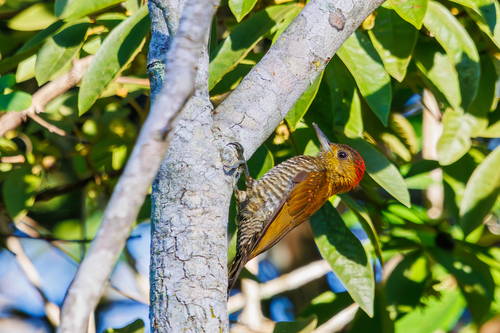
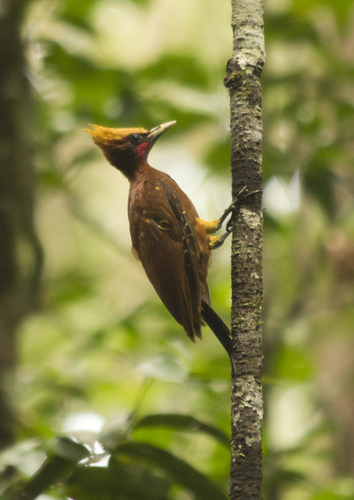
Across all subspecies, males have a wide bright red malar area and cheek, while females have no red on this region.
Nominate Subspecies Head Coloration
For the nominate subspecies C. e. elegans, adults of both sexes have a buffish cream forehead, crown, and crest. The rest of the head, including the chin and throat, is deep chestnut brown.
Nominate Subspecies Upperpart Coloration
Their upperparts are deep rufous-chestnut, with a cream-buff rump and uppertail coverts, and sometimes faint black bars on the back.
Nominate Subspecies Wing Structure and Coloration
Their flight feathers are blackish brown with rufous bars at the base, and their wing coverts have small white spots.
Nominate Subspecies Tail Coloration
Their tail feathers are blackish, with some rufous coloring on the outermost pair.
Nominate Subspecies Underpart Coloration
Their underparts are dark chestnut brown, and the belly and vent are sometimes lighter. Their flanks are a paler creamy cinnamon-buff, and often have obscure darker bars.
Adult Soft Part Coloration
Adult bills are ivory to yellow or greenish yellow, irises are red-brown to red, and legs are olive to dark gray.
Juvenile Plumage Traits
Juveniles are similar to adults, but have a dull blackish face and darker mottling on their underparts.
Subspecies Physical Variation
Different subspecies have distinct physical traits: C. e. hellmayri is somewhat darker overall than the nominate, especially on the crown, has more spots on its wing coverts and more bars on its flight feathers; C. e. deltanus has an even darker crown than C. e. hellmayri; C. e. leotaudi is paler and brighter than the nominate, with a tawny crown and a yellower rump; C. e. jumanus is darker overall than the nominate and the three preceding subspecies, has a shorter crest, rufous tips on its back feathers, no spots on its wing coverts, and more rufous on its flight feathers; C. e. citreopygius, like C. e. jumanus, has a short crest, but is blacker overall with less rufous.
Subspecies Geographic Distribution
Each subspecies has a separate distribution: C. e. hellmayri is found in eastern Venezuela, Guyana, western Suriname, and northern Roraima in Brazil; C. e. deltanus is found in Delta Amacuro state in northeastern Venezuela; C. e. leotaudi is found in Trinidad; C. e. elegans is found in eastern Suriname, French Guiana, and northern Brazil north of the Amazon between the Rio Branco and the state of Amapá; C. e. citreopygius is found in eastern Ecuador and eastern Peru; C. e. jumanus is found from eastern Colombia and southern Venezuela south through western and central Brazil into northern Bolivia.
Habitat Types
The chestnut woodpecker inhabits the interior and edges of both dense and open forests, including terra firme, gallery, and várzea forests. It also occurs in secondary forest and cocoa and other plantations.
Elevation Range by Country
Its maximum elevation range varies by country: it occurs from sea level to 1,000 m (3,300 ft) in Venezuela, up to 500 m (1,600 ft) in Colombia, up to 1,100 m (3,600 ft) in Peru, and up to 700 m (2,300 ft) in Ecuador (where it usually occurs below 500 m (1,600 ft)).