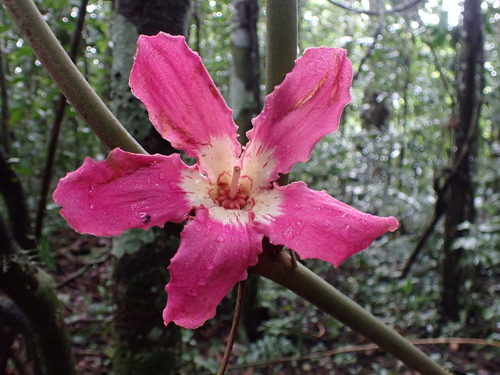
About Ceiba speciosa (A.St.-Hil., A.Juss. & Cambess.) Ravenna
Native Range
Ceiba speciosa, commonly known as the floss silk tree, has a natural native range covering northeast Argentina, eastern Bolivia, Paraguay, Uruguay, and southern Brazil.
Environmental Tolerance
This species is resistant to drought and moderate cold.
Growth Characteristics
It grows in fast spurts during periods of abundant water, and mature specimens can reach heights of over 25 metres (82 ft).
Trunk Shape
Its trunk has a distinctive bottle shape, typically bulging in the lower third, and can measure up to 2 metres (7 ft) in girth.
Trunk Prickles
The trunk is covered in large, sharp, conical prickles that stop wild animals from climbing the tree.
Trunk Coloration
Young trees have green trunks, thanks to a high chlorophyll content that lets the trunk perform photosynthesis when leaves are not present; as the tree ages, the trunk color fades to gray.
Seed Capsule Fiber Use
The cotton-like fiber inside the tree's seed capsules has been used as stuffing, with a density of 0.27 g/cm3, though its quality is lower than that of fiber from the kapok tree.
Wood Uses
The tree's wood can be used to make canoes, produce wood pulp, and manufacture paper.
Bark Uses
Bark from the floss silk tree has been used to make ropes.
Seed Oil Uses
Vegetable oil, suitable for both edible and industrial uses, can be extracted from the tree's seeds.
Ornamental Cultivation
The floss silk tree is primarily cultivated for ornamental purposes.
Urban Planting Range
Beyond private gardens across the world, it is often planted along urban streets in subtropical regions including Spain, South Africa, Australia, northern New Zealand, and the southern United States.
Cultivation Safety Considerations
However, the prickles on its trunk and limbs mean safety buffer zones must be established around planted trees to protect people and domesticated animals.
Ethnobotanical Use
Ceiba speciosa is added to some versions of the hallucinogenic drink Ayahuasca.