About Carpobrotus edulis (L.) N.E.Br.
Taxonomic Identity and Growth Habit
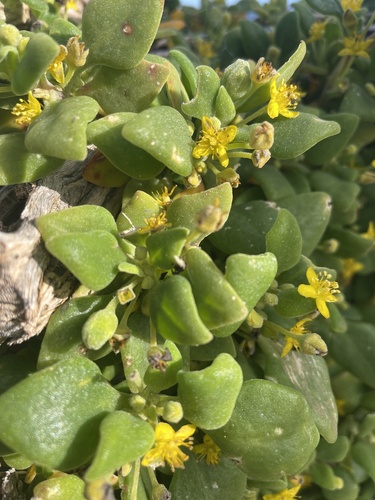
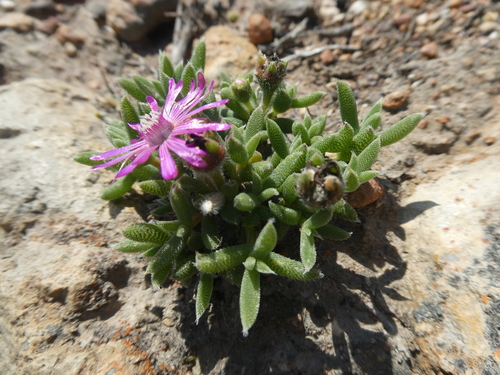
Carpobrotus edulis (L.) N.E.Br. is a creeping, mat-forming succulent species that grows year-round.
Growth Rate and Size
Individual shoot segments can grow more than 1 m (3 ft) per year, and the entire plant can reach at least 50 m (165 ft) in diameter.
Leaf Coloration
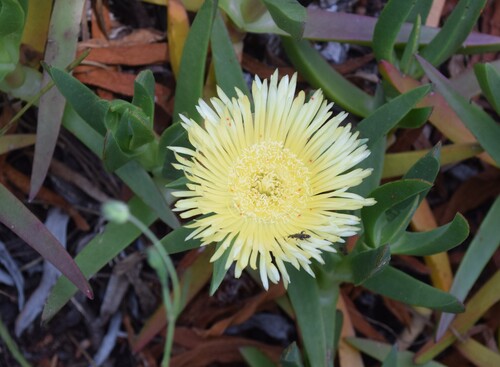
Its leaves are dull-green or yellow-green, and may fade to pink as they age.
Leaf Morphology
Leaves are very slightly curved, with serrated edges near their tips.
Flower Characteristics and Bloom Period
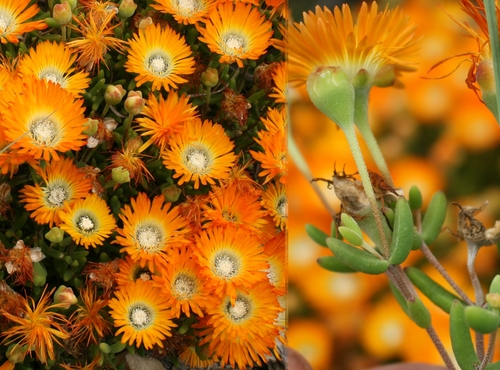
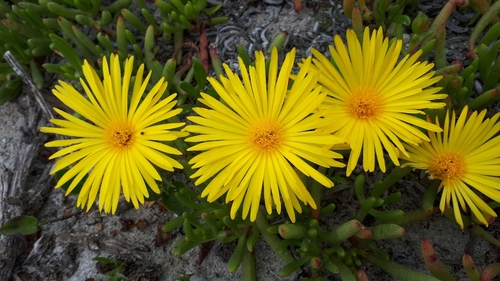
Yellow flowers, between 6.4 to 15.2 centimetres (2+1⁄2 to 6 inches) in diameter, bloom from April to October.
Calyx Lobe Traits
Two of the flower's calyx lobes are longer, extending past the petals.
Flower Opening Behavior
The flowers open in bright morning sunlight and close at night.
Receptacle Morphology
The receptacle is somewhat wedge-shaped, tapering toward the pedicel.
Fruit Development
The fruit is multi-chambered, and ripens from green to yellow.
Native Distribution
This species, commonly called sour fig, grows on coastal and inland slopes in South Africa, ranging from Namaqualand in the Northern Cape through the Western Cape to the Eastern Cape.
Ecological Role as Pioneer
It frequently acts as a pioneer species on disturbed sites.
Pollinators
Its flowers are pollinated by solitary bees, honey bees, carpenter bees, and many beetle species.
Fauna Consumption of Vegetative and Floral Parts
Tortoises eat its leaves, while antelopes and baboons eat its flowers.
Seed Dispersal Agents
Baboons, rodents, porcupines, and antelopes eat the fruit, and also disperse the plant's seeds.
Microhabitat for Small Fauna
Dense clumps of Carpobrotus edulis provide shelter for snails, lizards, and skinks.
Snake Use of Clumps
Puff adders and other snakes including the Cape cobra are often found within these clumps, where they ambush small rodents attracted to the plant's fruit.
Edibility Status
Both the fruit and leaves of Carpobrotus edulis are edible, as is true for some other members of the Aizoaceae family.
Culinary Uses of Fruit
In South Africa, ripe sour fig fruit is harvested to eat fresh, or made into a very tart jam.
Traditional Medicine Applications Overview
Different parts of C. edulis are used in various forms in traditional South African medicine.
Medicinal Use of Fruits and Flowers
Most commonly, fruits and flowers are eaten raw or cooked to treat fungal and bacterial infections.
Internal Medicinal Uses of Leaves
Leaves can be ingested orally to ease digestive problems, or their juice can be sucked to soothe a sore throat.
External Medicinal Uses of Leaf Juice
Leaf juice can also be mixed into a lotion base and used externally to address issues including ringworm, bruises, sunburns, and cracked lips.