About Capra nubiana F.Cuvier, 1825
Scientific Classification and Size Overview
Nubian ibex, scientifically named Capra nubiana F.Cuvier, 1825, are the smallest ibex species, consistent with Bergmann's rule. They stand roughly 65–75 cm (26–30 in) tall at the shoulder.
Sexual Dimorphism and Weight
This species is sexually dimorphic: males are substantially larger than females, with males averaging 52–74.7 kg (115–165 lb) and females averaging 25.3–32.7 kg (56–72 lb).
Body and Leg Coloration
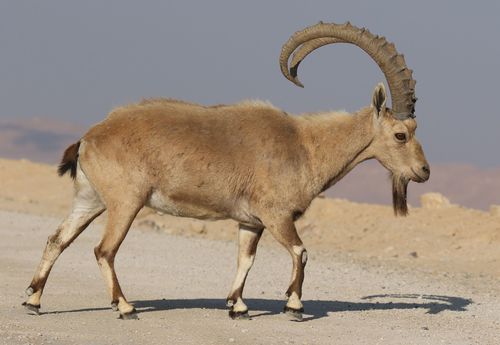
Their bodies are light tan with a white underbelly; males additionally have a dark brown mane running down their backs. Their legs have a distinct black and white pattern.
Rump and Tail Appearance
They have a lighter-colored rump paired with a dark brown tail.
Male Beard Development
Males begin growing a beard at 2 to 3 years of age, and the beard continues to grow longer and darker as the male ages.
Rutting Fur Timing
During the autumn breeding season, mature males grow a very dark brown "rutting fur" on their breast and sides. This fur appears in October for 3–4-year-old males, but may appear as early as July or August for older males aged 6 and up.
Rutting Fur Variability
Even when fully mature, not all males develop rutting fur.
Horn Shape
Nubian ibexes have long, thin horns that extend upward, then curve backward and downward.
Horn Length Dimorphism
In males, horn length reaches around 1 m (3 ft 3 in), while female horns are much smaller, reaching around 30 cm (12 in).
Horn Structure and Combat Function
Male horns are thicker than female horns, and grow large bulges that stop horns from sliding when males lock horns during combat.
Horn Growth Plateau Age
Male horn growth plateaus around 7–8 years of age, while female horn growth plateaus between 4–6 years of age.
Horn Ridges and Age Correlation
There is a clear relationship between an individual ibex's age and the number of horn ridges.
Historical Distribution
Historically, Nubian ibex ranged across the Middle East and Northeastern Africa.
Current Distribution
Today, their range falls within Egypt, Jordan, Oman, Israel, Palestine, Saudi Arabia and Sudan.
Lebanon Reintroduction Efforts
The species was extirpated in Lebanon, though a captive breeding and reintroduction process is currently underway there.
Extirpation in Syria
It has been fully extirpated in Syria.
Unconfirmed Presence Regions
Its presence is unconfirmed in Ethiopia, Eritrea and Yemen.
Mating Season Timing
Mating season for Nubian ibex typically occurs in October and November.
Dominant Male Mating Behavior
During this time, a dominant male will pursue multiple females. When females are in estrous, males produce a strong-scented secretion.
Mate Assessment Behavior
As they pursue potential mates, males curl their lips and smell the females' anal region.
Male Breeding Maturity
Males can reach breeding maturity as early as 2 years old, but they often cannot mate until age 5, when they are strong enough to fend off rival males.
Female Breeding Maturity
Females can breed as young as six months old, but most do not breed until they are 1–3 years old.
Second Mating Season Adaptation
Research indicates that some Nubian ibex subpopulations are developing a second spring mating season, as an adjustment to hyper-arid climates.
Gestation Period
Gestation lasts 5 months.
Birthing Season and Litter Size
Litters of 1–2 kids are born between March and July; the majority of births are synchronized within a 3–4 week period that peaks in late March and April.
Birthing Location Behavior
Females leave their herd to give birth in a secluded location.
Newborn Kid Development Milestones
Newborn kids can stand within 15 minutes of birth, and can nurse within two hours.
Post-Birth Herd Reintegration
The mother and her young rejoin the herd within a few days, then join other mothers and young to form a crèche that lasts for several weeks.
Crèche Ecological Benefit
Leaving kids in a sheltered crèche lets mothers access richer food patches and areas farther from cliffs, compared to mothers that keep their kids with them at all times.
Weaning Age
Kids are weaned around 4 months old.
Full Mature Size Age
Females reach full mature size at 3–4 years old, while males reach full mature size around 6 years old.
Lifespan
Nubian ibex can live up to 12 years in the wild and up to 18 years in captivity.