About Cantherhines pullus (Ranzani, 1842)
Species and Size
Cantherhines pullus, commonly called the orangespotted filefish, grows to a maximum length of about 20 cm (8 in).
Head Coloration
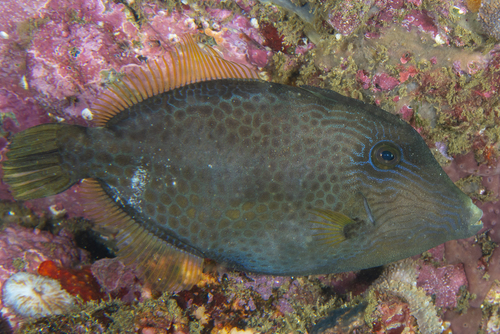
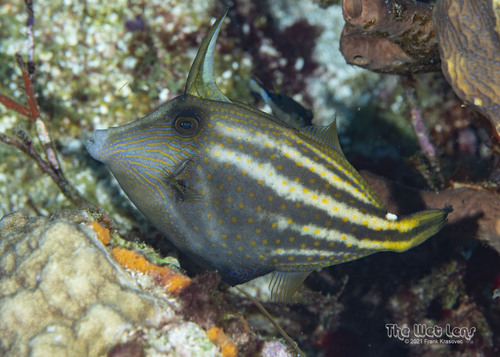
The head has several wavy yellowish lines that extend down onto the snout, and these lines alternate with bluish lines near the eyes.
Body Band Pattern
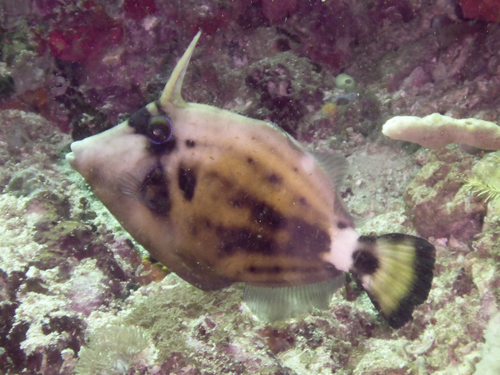
Its body features a number of broad brown bands, separated by narrow whitish-yellow bands that converge at the caudal peduncle and continue onto the tailfin.
Caudal Peduncle Markings
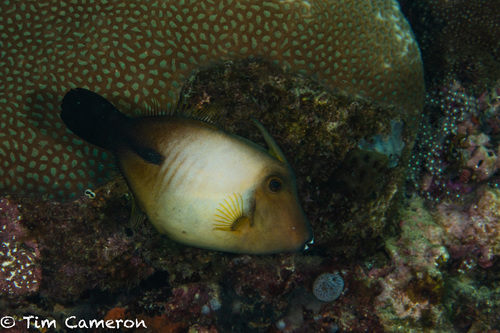
There is a moderate-sized white spot on the caudal peduncle, and there is often a smaller white spot located below this main spot.
Body Spot Pattern
The body is speckled with small orange spots, some of which have brown centers, alongside similar-sized white spots.
Dorsal Fin Structure
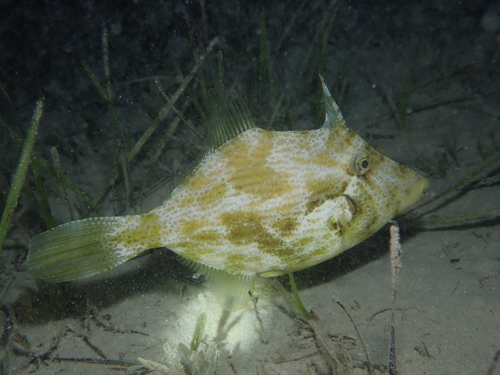
The first spine of the dorsal fin sits above the eye; it is very large, separate from the rest of the dorsal fin, and has a groove immediately behind its base that allows it to be folded away when not in use.
General Distribution
The orangespotted filefish is found in the Caribbean Sea, the northern half of the Gulf of Mexico, and tropical and subtropical waters of the Atlantic Ocean.
Atlantic Range Details
In the western Atlantic, its range stretches from Massachusetts to southeastern Brazil, while in the eastern Atlantic, it has been recorded from São Tomé and the Gulf of Guinea.
Depth Range
It typically inhabits reefs at depths ranging from around 3 to 50 m (10 to 160 ft), and it is most commonly found no deeper than 20 m (70 ft).
Habitat and Behavior
Orangespotted filefish usually swim close to the seabed over rocky and coral reefs, and hide among taller corals and gorgonians.
Diet
They feed mainly on sponges and algae, and also eat tunicates, bryozoans, and other bottom-dwelling invertebrates.
Juvenile Ecology
Juvenile orangespotted filefish live in the water column away from reefs, and are preyed upon by tuna, billfishes, and other large predatory fishes.
Human Interaction
Humans do not value this fish highly, and it is rarely eaten by people.