About Stephanolepis diaspros Fraser-Brunner, 1940
Scientific Naming
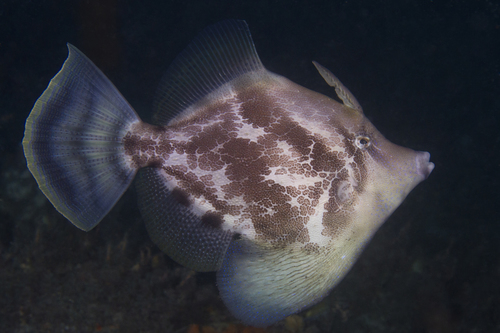
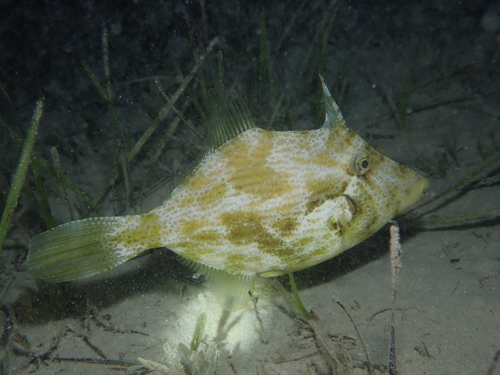
Stephanolepis diaspros Fraser-Brunner, 1940 has a deep, laterally compressed body that becomes rounded in profile on the ventral side.
First Dorsal Fin Structure
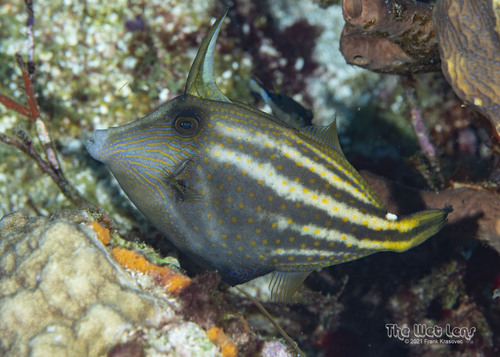
Its first dorsal fin has one strong spine with barbs along the posterior edge; this spine originates immediately above the posterior margin of the orbit.
Second Dorsal Fin Placement
The second dorsal fin sits directly above and runs parallel to the anal fin.
Second Dorsal Fin Ray
The second ray of the second dorsal fin is very long and filamentous, a trait that is especially prominent in males.
Pelvic Fin Structure
This species has no pelvic fin, and only has a simple flap of skin in that location.
Head Morphology
It has a pointed snout and a small terminal mouth that holds incisor-like teeth.
Gill Opening Characteristics
The gill opening is slit-shaped and positioned above the origin of the pelvic fin.
Body Skin and Scales
Its body is covered in rough, shark-like skin made up of tiny scales, each of which bears a fragile spinule.
Male Caudal Peduncle Features
Males have several rows of horny patches on the caudal peduncle.
Body Color Pattern
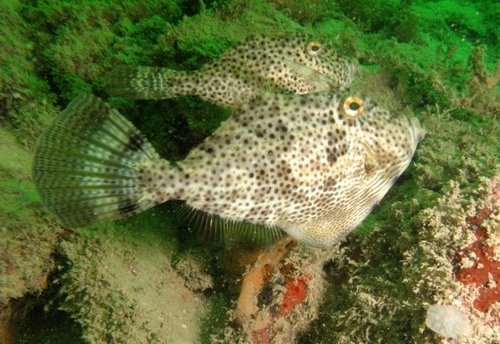
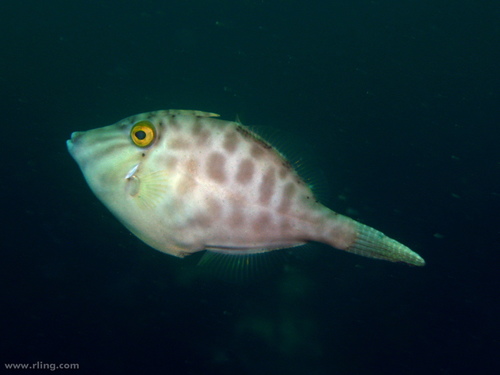
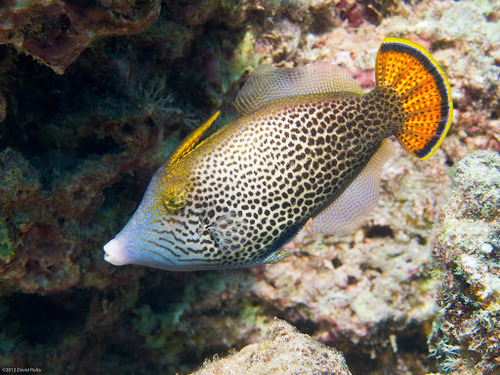
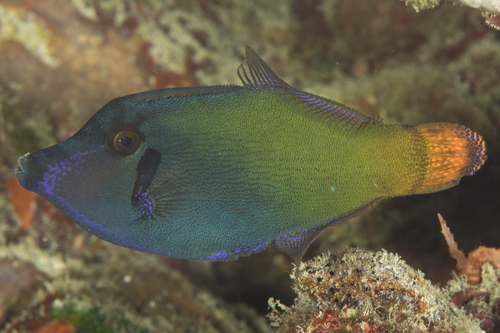
The body is brownish green or greyish green, with a complex pattern of spots, dark horizontal lines, and sinuous lines.
Fin Coloration
The convex caudal fin has two dark bands separated by a pale band, while the dorsal and anal fins range from yellow to orange in colour.
Maximum Length
Stephanolepis diaspros reaches a maximum total length of 25 centimetres.
Native Distribution
This species is distributed in the western Indian Ocean, ranging from the Red Sea south to the Horn of Africa, and along the coasts of the Arabian Peninsula to the Persian Gulf.
First Mediterranean Record
It was first recorded in the Mediterranean Sea in 1927 off the coast of Palestine.
Current Mediterranean Range
It is now very common throughout the entire eastern Mediterranean basin, and is expanding its range into the Adriatic Sea.