About Canis lupus rufus Audubon & Bachman, 1851
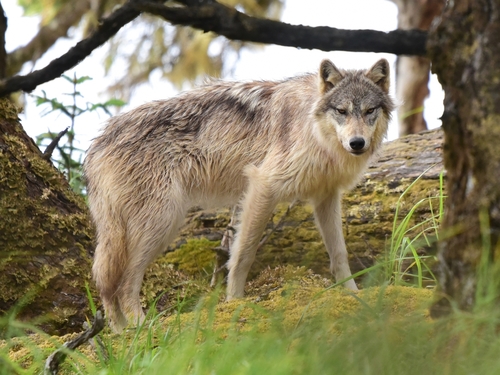
Canis lupus rufus Audubon & Bachman, 1851 (red wolf) is a subspecies of the gray wolf (Canis lupus). As a member of the Canidae family, the wolf is the largest living canid, and can be distinguished from coyotes and jackals by a broader snout, shorter ears, a shorter torso, and a longer tail. It has a slender, powerful build, with a large, deeply descending rib cage, a sloping back, and a heavily muscled neck. Its legs are moderately longer than those of other canids, which allows it to move quickly and travel through deep winter snow that covers most of its native range, though some wolf populations have shorter-legged ecomorphs. The ears are relatively small and triangular. The wolf's head is large and heavy, with a wide forehead, strong jaws, and a long, blunt muzzle. Wolf skulls measure 230–280 mm (9.1–11.0 in) long and 130–150 mm (5.1–5.9 in) wide. Its teeth are heavy and large, making them better suited for crushing bone than those of other canids, though they are not as specialized as hyena teeth. Its molars have a flat chewing surface, but not as flat as a coyote's, as coyotes consume more vegetable matter in their diet. Females typically have narrower muzzles and foreheads, thinner necks, slightly shorter legs, and less massive shoulders than males. Adult wolves measure 105–160 cm (41–63 in) in total length, and stand 80–85 cm (31–33 in) tall at the shoulder. Tails measure 29–50 cm (11–20 in) in length, ears measure 90–110 mm (3.5–4.3 in) in height, and hind feet measure 220–250 mm (8.7–9.8 in). The size and weight of modern wolves increases proportionally with latitude, following Bergmann's rule. The average mean body mass of a wolf is 40 kg (88 lb), with recorded weights ranging from 12 kg (26 lb) to 79.4 kg (175 lb). On average, European wolves weigh 38.5 kg (85 lb), North American wolves 36 kg (79 lb), and Indian and Arabian wolves 25 kg (55 lb). In any wolf population, females typically weigh 2.3–4.5 kg (5–10 lb) less than males. Wolves weighing over 54 kg (119 lb) are uncommon, though exceptionally large individuals have been recorded in Alaska and Canada. In central Russia, exceptionally large males can reach weights between 69–79 kg (152–174 lb).
Wolves currently occur across Eurasia and North America. Deliberate human persecution, driven by livestock predation and fear of wolf attacks on humans, has reduced the species' current range to roughly one-third of its historic range. Wolves are now locally extinct across much of their former range in Western Europe, the United States, and Mexico, and completely extirpated from the British Isles and Japan. In modern times, wolves are mostly found in wilderness and remote areas, occurring from sea level up to 3,000 m (9,800 ft) elevation. They inhabit forests, inland wetlands, shrublands, grasslands (including Arctic tundra), pastures, deserts, and rocky mountain peaks. Wolf habitat use depends on prey abundance, snow conditions, livestock densities, road densities, human presence, and topography. When adjusted for body mass, gray wolf home ranges measure 275–362.9 hectares/kg, which is comparable to cheetah home ranges (310.1 hectares/kg) and African wild dog home ranges (242.1 hectares/kg), but much larger than the body-mass-adjusted home ranges of spotted hyenas (8.3 hectares/kg) and lions (5.5 hectares/kg).
Wolves are monogamous, and mated pairs usually stay together for life. If one member of a pair dies, the other will find a new mate quickly. In wild wolf populations, inbreeding does not occur when outbreeding is possible. Wolves reach physical maturity at two years of age, and sexual maturity at three years of age. The age of first breeding for wolves depends heavily on environmental conditions: when food is abundant, or when wolf populations are actively managed, wolves can rear pups at younger ages to take advantage of available resources. Females are capable of producing a litter of pups every year, with one litter per year being the average. Oestrus and rut start in the second half of winter and last for two weeks. Dens are most often constructed for raising pups during the summer. When building dens, females use natural shelters such as rock fissures, cliffs overhanging riverbanks, and thickly vegetated holes. Sometimes wolves take over burrows originally dug by smaller animals such as foxes, badgers, or marmots, and will usually widen and partially remake an appropriated burrow for their own use. Female wolves only dig their own burrows on rare occasions; these self-dug burrows are usually small and short, with one to three openings. Dens are usually built no more than 500 m (1,600 ft) away from a water source, and typically face south to receive more sunlight for better warming and faster snow thaw. Resting spots, play areas for pups, and food remains are commonly found around wolf dens. The smell of urine and rotting food from the den area often attracts scavenging birds such as magpies and ravens. While wolves mostly avoid areas visible to humans, they have been recorded nesting near human settlements, paved roads, and railways. During pregnancy, female wolves stay in a den located away from the outer edges of their territory, where violent encounters with other wolf packs are less likely. The gestation period lasts 62–75 days, with pups usually born in spring, or early summer in very cold regions like the tundra. Young females give birth to four to five pups per litter, while older females produce six to eight pups, with litters as large as 14 recorded. Pup mortality rates range from 60% to 80%. Newborn wolf pups look similar to German Shepherd Dog pups. They are born blind and deaf, and covered in short, soft greyish-brown fur. They weigh 300–500 g (11–18 oz) at birth, and begin to see between nine to 12 days after birth. Milk canines erupt after one month. Pups first leave the den after three weeks. At one and a half months of age, they are agile enough to flee from danger. Mother wolves do not leave the den for the first few weeks after birth, relying on the father to provide food for them and their young. Pups begin eating solid food at three to four weeks of age. They grow very quickly during their first four months of life, during which a pup's weight can increase by nearly 30 times. Wolf pups begin play-fighting at three weeks old; unlike young coyotes and foxes, their bites during play are gentle and controlled. Actual fights to establish social hierarchy usually occur between five to eight weeks of age, which differs from young coyotes and foxes, which may start fighting even before they develop play behavior. By autumn, pups are mature enough to join adult wolves on hunts for large prey.