About Callithrix aurita (É.Geoffroy Saint-Hilaire, 1812)
Base Coloration
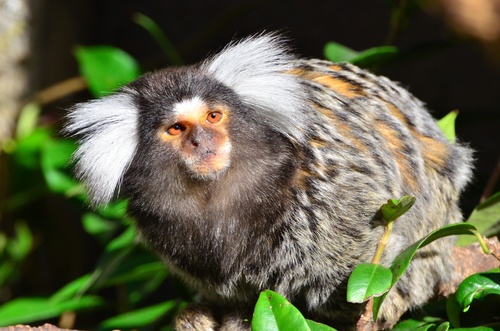
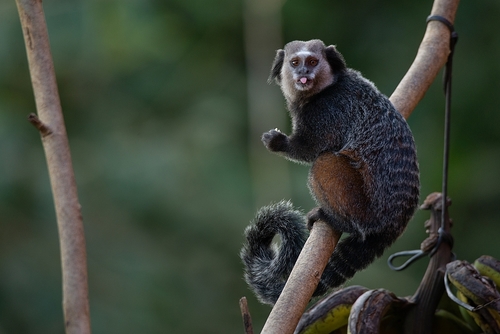
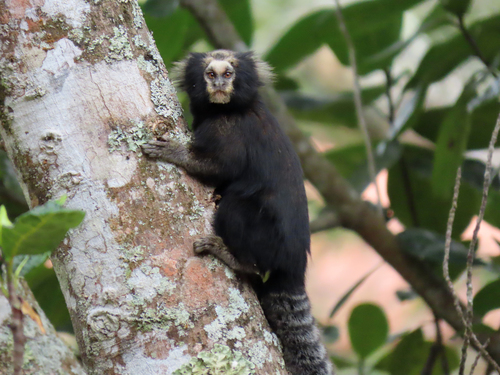
Callithrix aurita, commonly called the buffy-tufted marmoset, has an overall black base coloration, though individuals may have reddish spots or red speckling with no consistent striped pattern. These reddish spots create the characteristic golden hue that inspired the species epithet "aurita".
Facial and Ear Features
The species has a white forehead, black sides of the face that are sometimes speckled with red, and short white intra-auricular tufts (20 to 50 mm long) that can shift to a brownish shade.
Limb and Tail Traits
Its feet are brown, while its hands are a deep, weathered brown, and its tail is black with white rings.
Size Measurements
It is likely the largest species in the Callithrix genus, with a body weight of 400–450 g, a body length of 19–25 cm, and a tail length of 27–35 cm.
Geographic Range
The buffy-tufted marmoset is endemic to the Atlantic Forest of southern Brazil. It occurs in ombrophilous and semideciduous forests in the Serras do Mar and Mantiqueira regions across the states of Minas Gerais, São Paulo, and Rio de Janeiro, and its range extends north of the Rio Doce in Minas Gerais.
Foraging Height
The species forages and travels through the lower canopy and dense understorey vegetation, most often found 6 to 9 meters above ground.
Climatic Tolerance
Alongside C. flaviceps, it is one of two Callithrix species that inhabit areas with the most extreme climatic conditions.
Habitat Altitude Range
It can be found in perennial, semideciduous, secondary, and mixed montane forests interspersed with bamboo stands, at altitudes ranging from 80 to 1200 meters.
Activity Pattern
This species is diurnal and arboreal, spending almost its entire life in trees.
Social Group Structure
It lives in social groups that usually contain 4 to 8 individuals, though groups as large as 11 individuals have been recorded. Groups only have one reproductive male-female pair, led by a dominant female.
Reproduction Traits
Offspring are always born as twins, after a 144-day gestation period. Parents carry the newborn offspring in their first weeks of life, and older siblings help care for the young.
Adult Dispersal
When individuals reach adulthood, they migrate to other groups to form new breeding pairs.
Seasonal Activity Shifts
The species' active period is shortened during the hot-dry season: activity runs from 6:30 to 19:00 in the rainy season, and from 7:30 to 16:30 in the dry season. Resting sites are located in areas of dense vegetation.
Typical Diet
Its diet consists of plant resins and other plant secretions, along with other plant material including fruits and tree gum.
Dry Season Diet Adaptations
During dry periods, it adapts its diet to include animal matter such as lepidoptera larvae, orthopterans, cockroaches, spiders, harvestmen, snakes, lizards, small frogs, and bird eggs. Research has also recorded this species feeding on bamboo fungi.
Sympatry Relationships
It can live in sympatry with species from genera such as Cebus and Callicebus, but there are no recorded instances of sympatry with other Callithrix species.