About Saguinus oedipus (Linnaeus, 1758)
Taxonomy and Naming
The cotton-top tamarin, scientifically named Saguinus oedipus (Linnaeus, 1758), belongs to Callitrichidae, the smallest monkey family that includes marmosets and tamarins.
Size Measurements
On average, this species weighs 432 g (15.2 oz), with a head-body length of 20.8–25.9 cm (8.2–10.2 in). Its non-prehensile tail is slightly longer, measuring around 33–41 cm (13–16 in). The species has no sexual dimorphism, meaning males and females have similar size and weight.
Digit Nail Structure
Like other members of the Callitrichinae subfamily, it has sharp tegulae (nail structures similar to a squirrel's claws that aid tree movement) on all digits except the big toes, which have flat ungulae, the type of flat nail common to other primates.
Head Crest Appearance
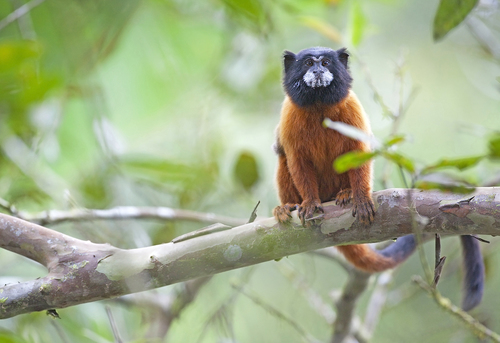
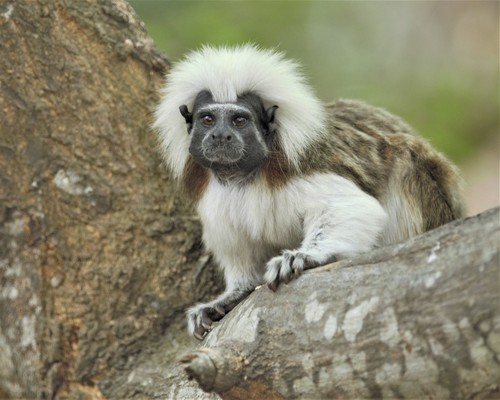
The cotton-top tamarin has a long sagittal crest of white hairs that runs from its forehead to the nape and flows over its shoulders.
Facial Markings
Its facial skin is black, with gray or white bands above the eyes that continue along the edge of the face down to the jaw.
Tamarin Facial Classification
Tamarins are grouped into three categories by facial features: hairy-faced, mottled-faced, and bare-faced. Although fine white hair covers the cotton-top tamarin's face, the hairs are so fine that the face appears naked, so the species is classified as a bare-faced tamarin.
Dental Characteristics
Its lower canine teeth are longer than its incisors, which creates a tusk-like appearance. Like other callitrichids, the cotton-top tamarin has two molar teeth on each side of the jaw, unlike other New World monkeys which have three.
Fur Coverage
Fur covers the entire body of the cotton-top tamarin, with the exception of the palms of the hands and feet, the eyelids, the borders of the nostrils, the nipples, the anus, and the penis.
Body Fur Coloration
Its back is brown, while its underparts, arms, and legs are whitish-yellow, and its rump, inner thighs, and upper tail are reddish-orange.
Fur Density Variation
Fur density varies across the body: density is lower in the genital region (the scrotum and pubic zone), the axilla, and the base of the tail, while it is much higher in the forward region of the body.
Distinctive Fur Markings
Many individuals have distinctively colored stripes or fur whorls on their throats. The species also has whiskers on its forehead and around its mouth.
Geographical Range
The cotton-top tamarin is only found in a small area of northwest Colombia, bounded by the Cauca and Magdalena Rivers to the south and east, the Atlantic coast to the north, and the Atrato River to the west, and it occurs exclusively in Colombia.
Habitat Loss Status
Around 98% of its original habitat has been destroyed. The entire historical range was once suitable habitat, but deforestation has caused habitat loss, so the species now only survives in fragmented parks and reserves.
Key Protected Habitat
Paramillo National Park, which covers 460,000 hectares (1,800 mi²) of primary and secondary forest, is one of the most important protected areas for this species.
Forest Habitat Types
The cotton-top tamarin lives in both primary and secondary forests, ranging from humid tropical forests in the southern part of its range to tropical dry forests in the north.
Altitude Range
It is rarely found at altitudes above 400 m (1,300 ft), though it has been recorded as high as 1,500 m (4,900 ft).
Habitat Vertical Use
It prefers the lower levels of tropical forests, but may also forage on the ground and move between the understory and the canopy. It can adapt to forest fragments and survive in relatively disturbed habitats.
Local Climate Seasons
The dry forests within its range have distinct seasons: the dry season runs from December to April, and heavy rainfall occurs between August and November, which can flood the forest floor.
Annual Rainfall Range
Across its range, annual rainfall ranges from 500 to 1,300 mm (20 to 51 in).
Diet Composition
The diet of the cotton-top tamarin is made up of around 40% fruit and 40% animal material. It also eats plant exudates such as gum and sap, nectar, and occasionally reptiles and amphibians.
Dietary Requirements
Because of its small body size and fast food passage rate, it requires a high-quality, high-energy diet.
Insect Foraging Methods
Insectivory is common, and the cotton-top tamarin uses multiple methods to hunt insects: stealth, pouncing, chasing, exploring holes, and turning over leaves.
Seed Dispersal Role
Cotton-top tamarins act as seed dispersers in tropical ecosystems. While larger primates eat larger seeds, tamarins consume smaller seeds.
Seed Consumption Benefits
Seeds expelled by tamarins have a higher germination rate than other seeds, and ingesting larger seeds may help dislodge and expel intestinal parasites.
Daily Activity Pattern
The cotton-top tamarin is diurnal, and sleeps with its social group in trees covered in dense foliage. The entire group leaves the sleeping tree together one hour after dawn, and spends the day foraging, resting, travelling, and grooming.
Predator Avoidance Behavior
The species is thought to wake later in the day and increase the speed of its foraging and travel before dusk to avoid crepuscular and nocturnal predators.
Known Predators
Its main predators include raptors, mustelids, felids, and snakes.
Vigilance Behavior
The cotton-top tamarin is extremely vigilant, and constantly scans for potential predators. When the group is resting, one individual will move away from the group to act as a lookout, and alerts the group if a threat is spotted.
Lifespan
Cotton-top tamarins can live up to 24 years in captivity, while the average lifespan for wild individuals is 13 years.
Food-Related Vocalization Types
The cotton-top tamarin produces selective, specialized vocalizations when food is present. These include the C-call, which is made when a tamarin approaches and sorts through food, and the D-call, which is linked to food retrieval and is given while eating.
C-Call Function
C-call chirping is thought to be an honest signal that communicates food preference. A cotton-top tamarin will produce C-call chirps more often and more rapidly when approaching a highly favored food source. Functionally, this behavior lets other tamarins know what the caller will do in a feeding situation, and alerts them if a preferred food source is available.
Vocalization Context Variation
Though some research indicates that food calls provide information to other group members, other observations of cotton-top tamarins show that the quantity, distribution of food, and the presence of other group members do not significantly change how much a caller produces food-centered vocalizations. Cotton-top tamarins make food calls both when other group members are present and when they are alone.
Vocalization Response
Additionally, other tamarins respond to food calls by directing their response back to the original caller, even without visually confirming that a food source is present.
Communication Interpretation
While this might seem to be a product of a very primitive form of communication, Roush and Snowdon (2005) argue that this food-calling behavior conveys some mentally representable information about food to recipient tamarins.