About Buddleja stachyoides Cham. & Schltdl.
Species Identification
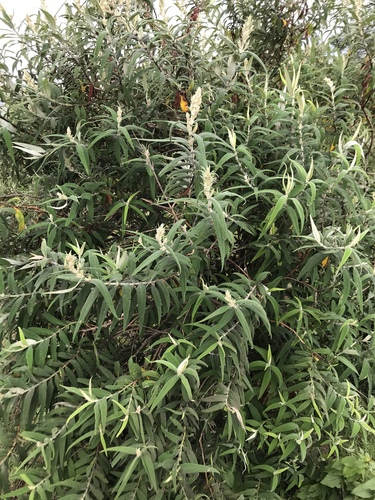
Buddleja stachyoides Cham. & Schltdl. is a shrub that reaches 1 to 3.5 meters in height.
Reproductive Biology
Unlike most South American members of the Buddleja genus, which are cryptically dioecious, B. stachyoides is hermaphroditic and produces perfect flowers.
Branch Characteristics
Its young branches are quadrangular, occasionally winged, and covered in a greyish tomentum.
Leaf Morphology
Its leaves are either subsessile or borne on a petiole shorter than 1 cm; the leaf blades are ovate or oblong-lanceolate, 5–20 cm long and 3–8 cm wide, membranaceous, becoming glabrescent on the upper surface and remaining tomentose on the lower surface.
Inflorescence and Flower Features
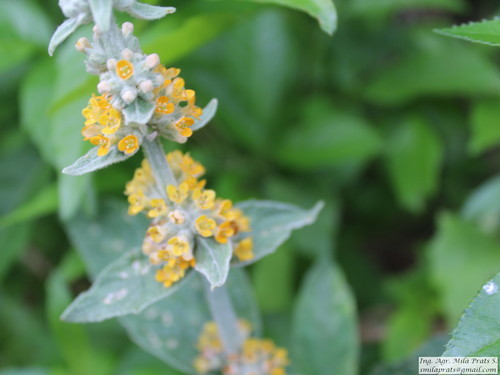
Its yellow to pale orange inflorescence is unbranched, 10–20 cm long, and made up of 4–20 pairs of axillary cymes; the tubular corolla measures 5–7 mm in length.
Chromosome Count
The chromosome count for this species is 2n = 38.
Cultivation Locations
Buddleja stachyoides is currently cultivated under glass in the United Kingdom, at the Royal Botanic Gardens Kew, Cambridge Botanic Garden, and the NCCPG national collection held at Longstock Park Nursery near Stockbridge, Hampshire.
Naturalized Range
It has naturalized outside its native range: along a creek bank at Ashgrove near Brisbane in Australia, and on the islands of St Helena and Réunion.
Hardiness
It is hardy in USDA zones 9–11.