About Buddleja davidii Franch.
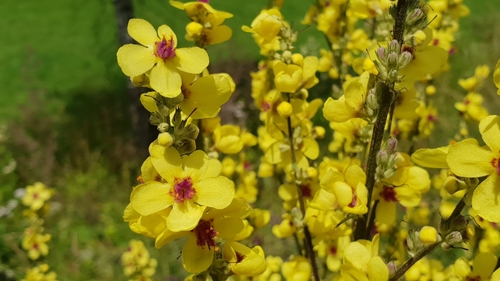
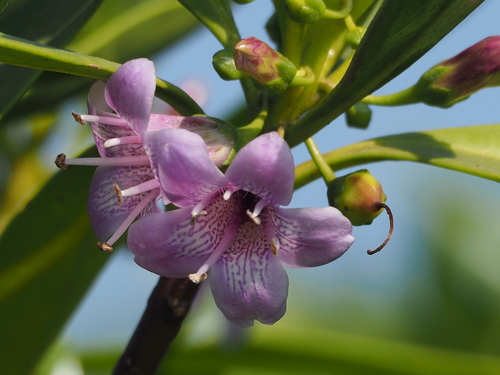
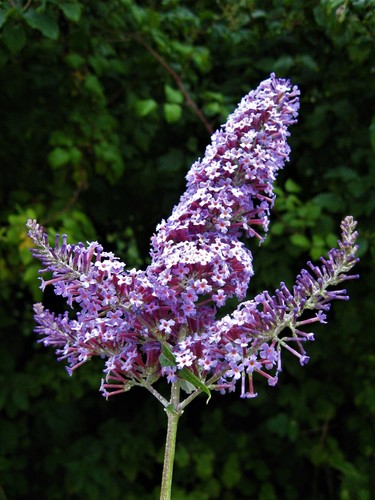
Buddleja davidii Franch. is a vigorous, arching-growing shrub that reaches up to 5 m (16 ft) in height. Its pale grey-brown bark develops a flaky to deeply fissured texture as it ages. Branches have a quadrangular cross-section, and younger shoots and leaves are covered in a dense indumentum. The opposite, lanceolate leaves measure 7–20 cm (3–8 inches) long and 2–7 cm (1–3 inches) broad; they are grey-green to dark green on the upper surface, and when young they are greyish-white and tomentose beneath, fading to grey-green with age. The flowers carry a honey scent, and range in color from lilac to purple, occasionally white. They grow in terminal panicles that are usually under 20 cm (8 inches) long, but can reach 30 cm (12 inches) or more. Each flower is perfect, containing both male and female parts, making the species hermaphrodite — this corrects the common incorrect claim that it is monoecious, meaning it bears separate male and female flowers on the same plant. Buddleja davidii is tetraploid, with a ploidy of 2n = 76. Its very small seeds are dispersed by wind.
Cultivars of Buddleja davidii are widely grown across the world as ornamental shrubs, and are valued for their flowers that provide nectar for many butterfly species. The plant does not act as a food source for butterfly larvae, however, and it may out-compete the host plants that caterpillars need to survive. The species and its cultivars cannot survive harsh winters in northern or montane climates, and are killed by temperatures between roughly −15 to −20 °C (5 to −4 °F). Younger wood produces more flowers, so even if frost does not kill the previous year’s growth, the shrub can be hard-pruned in spring after all frosts have ended to encourage new growth. Removing spent flower panicles can reduce unwanted self-seeding and stimulate additional flower production, which extends the flowering season that otherwise lasts only about six weeks. Second and third flushes of flowers are always smaller than the first. This species is rated hardy for USDA zones 5–9.
There are roughly 180 known Buddleja davidii cultivars, plus numerous hybrids — including crosses with Buddleja globosa and Buddleja fallowiana — grown in gardens. Some cultivars have a dwarf growth habit, reaching no more than 1.5 m (5 feet) in height. Over a six-year trial period, a plant-evaluation manager at the Chicago Botanic Garden, located in Glencoe, Illinois (USDA Hardiness zone 5b), rated nearly 50 Buddleja varieties and cultivars, publishing a summary of each cultivar’s characteristics and the study’s findings in 2015. University studies have found that nectaring-foraging butterflies prefer some Buddleja cultivars over others; out of eleven tested cultivars, Lo & Behold 'Blue Chip' and 'Pink Delight' were the most preferred. Other notable cultivars and hybrids include 'Golden Glow' and 'Silver Frost'.