About Bothrops ammodytoides Leybold, 1873
Species Identity
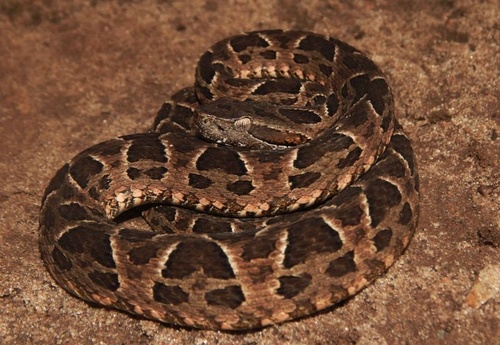
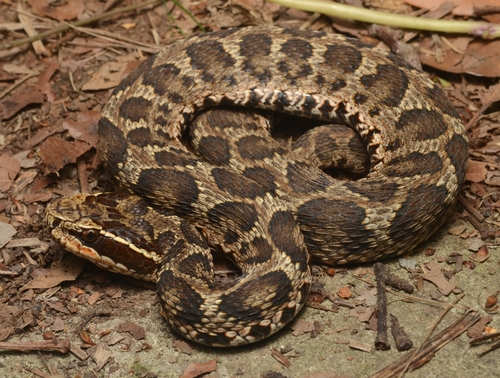
This species, Bothrops ammodytoides, has a stocky build.
Size
It reaches an average total length of 45–75 cm (18–30 inches), and can grow to almost 1 m (39 inches) in total length.
Head Shape
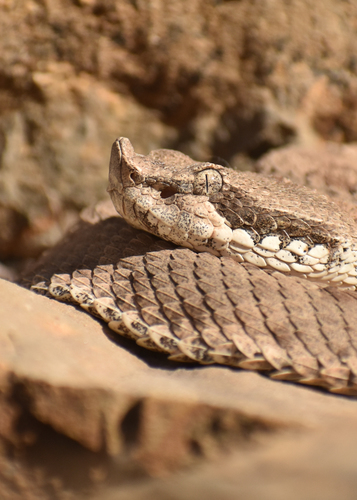
Its rostral scale is elongated vertically, and its snout is upturned, a feature similar to that of hog-nosed pitvipers of the genus Porthidium.
Dorsal Body Coloration
Dorsally, the body is pale brown, marked with a series of large, squarish dark brown spots or crossbars that are edged in black. In some individuals, these markings alternate to form a zigzag stripe.
Head Coloration
A dark streak runs behind the eye.
Ventral Body Coloration
Ventrally, the body is yellowish with scattered brown dots.
Midbody Dorsal Scales
The dorsal scales are very strongly keeled, arranged in 23 or 25 rows at midbody.
Ventral and Subcaudal Scales
It has 149–160 ventrals, an entire anal plate, and 30–38 divided subcaudals.
Head Dorsal Scales
The dorsal surface of the head is covered in small, imbricate, keeled scales. The large supraocular scales are separated by 8 or 9 rows of these small scales.
Ocular and Labial Scales
Two rows of scales separate the eye from the upper labials. There are 9 or 10 upper labials; the second upper labial is separated from the loreal pit, and the third and fourth upper labials are the largest.
Temporal Scales
The temporal scales are keeled.
Country Distribution
This species is found only in Argentina, in the provinces of Buenos Aires, Catamarca, Córdoba, Chubut, La Pampa, La Rioja, Mendoza, Neuquén, Río Negro, San Juan, San Luis, Santa Cruz, and Tucumán.
Altitude Range
Its vertical distribution ranges from sea level to at least 2,000 m (6,600 ft) in altitude.
Type Locality
The type locality was first recorded as "northern Argentina", and later emended to "province of Mendoza" by Campbell and Lamar (1989).
Southernmost Range Note
The geographic range of Bothrops ammodytoides extends to 47° S Latitude, which may make it the world's southernmost snake.
Habitat Climate and Vegetation
It prefers dry regions, and occurs in temperate to subtropical savannas and steppes.
Habitat Substrate and Landforms
It is found mostly in sandy, rocky areas, including coastal dunes, steep riverbanks, and salt flats.
High Altitude Habitat
Near the upper limits of its altitude range, it can occasionally be found in broadleaf evergreen forest.
Venom Effects
The venom of Bothrops ammodytoides is potentially lethal to humans, causing internal bleeding and tissue damage around the bite wound.
Defensive Behavior
These snakes are defensive of their territory and become aggressive when disturbed.