About Bison bonasus (Linnaeus, 1758)
Scientific Nomenclature
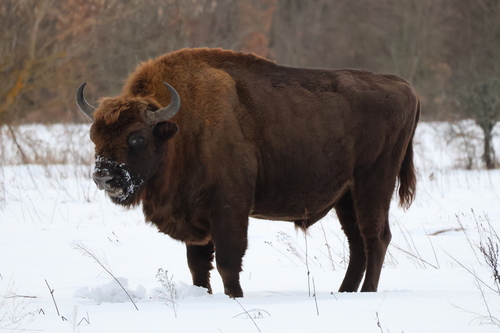
The European bison, scientifically named Bison bonasus (Linnaeus, 1758), is the heaviest wild land animal still surviving in Europe.
Historical Size Comparison
Similar to its American bison relatives, historical European bison were generally larger than the remaining modern descendant populations.
Adult Male Size
Modern adult males have a body length (excluding the tail) of 2.8 to 3.3 m (9.2 to 10.8 ft), a tail length of 30 to 92 cm (12 to 36 in), a shoulder height of 1.8 to 2.1 m (5.9 to 6.9 ft), and a weight of 615 to 920 kg (1,356 to 2,028 lb).
Adult Female Size
Modern adult females have a body length (excluding the tail) of 2.4 to 2.9 m (7.9 to 9.5 ft), a shoulder height of 1.69 to 1.97 m (5.5 to 6.5 ft), and a weight of 424 to 633 kg (935 to 1,396 lb).
Newborn Calf Weight
Newborn calves are small, weighing between 15 and 35 kg (33 and 77 lb).
Białowieża Forest Adult Average Weight
Among free-ranging adults aged 6 and older in Białowieża Forest (shared by Belarus and Poland), males average 634 kg (1,398 lb) and females average 424 kg (935 lb).
Maximum Recorded Weight
Exceptionally large adult bull European bison can weigh 1,000 kg (2,200 lb) or more; old recorded weights reach 1,900 kg (4,200 lb) for lowland wisent and 1,000 kg (2,200 lb) for Caucasian wisent.
Comparison to American Bison
Compared to its American relatives, the wood bison (Bison bison athabascae) and plains bison (Bison bison bison), the European bison averages lighter in body mass but slightly taller at the shoulder.
Morphological Differences from American Bison
It also has shorter hair on the neck, head, and forequarters, along with a longer tail and longer horns than the American bison.
Vocalization Overview
European bison produce a range of vocalizations that match their mood and behavior.
Anxiety and Mating Vocalization
When anxious, they make a growl-like sound called chruczenie ([xrutʂɛɲɛ]) in Polish; this sound can also be heard from male wisent during mating season.
Core Herd Distribution
The largest current European bison herds, including both captive and wild populations, are still found in Poland and Belarus.
Białowieża Forest Herd Details
Most of these herds are located in Białowieża Forest, which holds the world's most numerous free-living European bison population, with most individuals living on the Polish side of the Poland-Belarus border.
Global Breeding Center
Poland remains the global breeding center for the species.
Białowieża Breeding Transfers
Between 1945 and 2014, 553 individuals from Białowieża National Park alone were sent to most captive European bison populations across Europe, as well as all Polish breeding sanctuaries for the species.
Altai Mountains Reintroduced Population
A small reintroduced population has lived in the Altai Mountains since 1983.
Altai Population Genetic Status
This population experiences inbreeding depression and requires the introduction of unrelated individuals to refresh its genetic pool.
Altai Population Management Goals
Long-term management goals aim to establish a stable population of around 1,000 animals in the area.
Vologodskaya Oblast Population
One of the northernmost existing European bison populations lives in Vologodskaya Oblast, in the Northern Dvina valley around 60°N, and this population survives without supplementary winter feeding.
Desna River Border Population
Another Russian population inhabits forests around the Desna River along the border between Russia and Ukraine.
Pleistocene Park Population Location
The north-easternmost population resides in Pleistocene Park, south of Chersky in Siberia.
Pleistocene Park Context
Pleistocene Park is a project to recreate the mammoth steppe ecosystem, which began changing 10,000 years ago.
Pleistocene Park Introduction Details
Five wisent were introduced to the park on 24 April 2011; they were transported from Prioksko-Terrasny Nature Reserve near Moscow, and originated from a Danish population.
Pleistocene Park Acclimatization Mortality
Winter temperatures in the area often drop below −50 °C, and four of the five introduced bison died after failing to acclimatize to the extreme low winter temperatures.
Western Europe Reintroduction Plans
Reintroduction plans for two separate herds are underway in Germany and in the Netherlands, at Oostvaardersplassen Nature Reserve in Flevoland and the Veluwe.
Netherlands Zuid-Kennemerland Pilot Project
In 2007, a pilot bison project was launched in a fenced area of Zuid-Kennemerland National Park in the Netherlands.
Netherlands Maashorst Release
In March 2016, a herd was released in Maashorst Nature Reserve in North Brabant, the Netherlands.
Global Captive Breeding Programs
Zoos across 30 countries maintain many European bison as part of captive-breeding programs.
Disease Vulnerability
Due to the species' limited genetic pool, European bison are considered highly vulnerable to illnesses such as foot-and-mouth disease.
Rutting Season Timing
The species' rutting season runs from August through October.
Young Bull Mating Access
Bulls aged 4 to 6 years old are sexually mature but are kept from mating by older bulls.
Gestation and Birth Details
Cows typically have a gestation period of 264 days, and usually give birth to a single calf per pregnancy.
Newborn Weight by Sex
On average, male newborns weigh 27.6 kg (60.8 lb) at birth, while female newborns weigh 24.4 kg (53.8 lb).
Male Growth Timeline
Male body size increases proportionally until the age of 6 years.
Female Growth Rate
While females gain more body mass in their first year, their growth rate becomes slower than males by the age of 3 to 5 years.
Sexual Maturity Age
Bulls reach sexual maturity at 2 years old, and cows reach sexual maturity at 3 years old.
Captive Lifespan
In captivity, European bison have lived up to 30 years.
Wild Lifespan
In the wild, their typical lifespan ranges from 18 to 24 years, and females generally live longer than males.
Productive Breeding Age Range
The productive breeding age range is 4 to 20 years old for females, and only 6 to 12 years old for males.