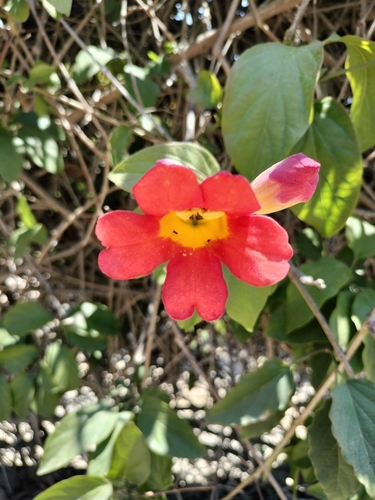
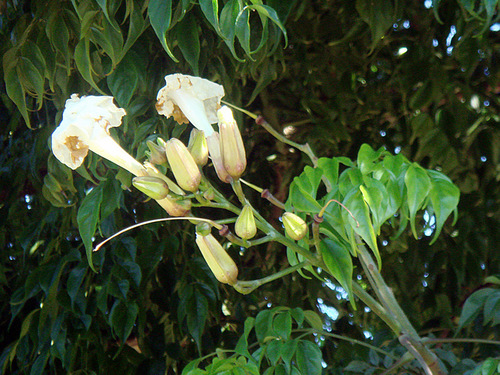
About Bignonia capreolata L.
Common Name Origin
Bignonia capreolata L. is a vine most commonly known as crossvine. Its common name comes from the cross-shaped pattern visible when the stem is cut, which forms from four radial wedges of phloem embedded within the stem's xylem.
Native Range
This species is native to the central and southern United States.
Climbing Mechanism
This climbing vine does not climb via twining, and instead produces tendrils for climbing.
Flower Characteristics
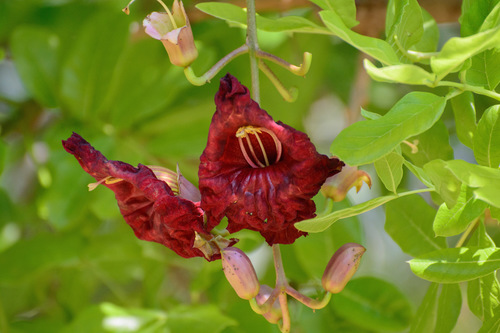
It bears long tubular flowers that are red and yellow, and often have a mocha fragrance.
Leaf Characteristics
Its leaves range from dark green to nearly purple, grow in opposite pairs, and have terminal tendrils. The vine often climbs to great heights, and leaves only remain on the uppermost portion of the plant.
Horticultural Management
Crossvine can spread aggressively through stolons, and may require active management when grown in garden or domestic settings.
Scientific Naming Confusion
For a period of time, there was confusion surrounding this plant's scientific name: it was sometimes called Bignonia crucigera, a name that correctly refers to an entirely different plant.
Habitat Types
Bignonia capreolata is native to the southeastern United States, where it is most often found growing in woodlands, thickets, and along riverbanks.
Range Extent
Its natural range extends from Maryland and Virginia south to Florida, and west to Texas and Oklahoma.
Climate Adaptation
It is most abundant in warm, humid climates, but has adapted to cooler environments in the northern part of its range.
Forest Habitat Behavior
It often grows in mixed forests, where it climbs trees and shrubs to reach sunlight.
Urban Landscape Use
It grows equally well in suburban and urban landscapes, where it is used to create green walls and shaded areas.
Hardiness Zones
This species grows best in USDA hardiness zones 5 through 9.
Soil Preferences
It prefers well-drained, slightly acidic soils, but can adapt to sandy, loamy, and clay soil types.
Light Requirements
While it performs best in full sun, it tolerates partial shade, though lower sunlight levels can reduce flower production.
Ornamental Appeal
Because of its vibrant flowers and dense foliage, Bignonia capreolata is a popular decorative plant. It is often used to cover pergolas, arbors, fences, and walls, forming a lush, natural canopy.
Landscaping Utility
Its fast growth and ability to climb vertical structures make it especially useful for landscaping projects that need to add height or cover unsightly areas.
Erosion Control Use
This vine is also frequently planted for erosion control along slopes and riverbanks, where its extensive root system helps stabilize soil.
Wildlife Value
It can grow well in a range of conditions, and its tubular flowers attract hummingbirds and butterflies.
18th Century Medicinal Record
There is one recorded 18th century account of a medicinal use of crossvine by the Cherokee people. The description notes that the vines or climbing stems are split longitudinally into four parts by four membranes that somewhat resemble a piece of white tape; when the vine is cut crosswise, this structure creates a cross shape.
Membrane Taste
The membrane has a sweet, pleasant taste.
Historical Diet Drink Use
Carolina country people cut these vines into pieces, boiled them together with china brier and sassafras roots in beer to make a spring diet drink, intended to thin and purify the blood and body juices.
Yaws Treatment Use
It was also a main ingredient in Howard's famous infusion for treating yaws, which Howard learned its use and properties from Indian Doctors.
2012 Chemical Identification
In 2012, researchers from Bastyr University published a paper reporting that they had identified the indole alkaloid reserpine in crossvine.
Additional Native American Medicinal Uses
Native Americans used this vine for a number of health complaints: an infusion of its leaves was used to purify blood, crushed bark was used to treat edema and headaches, and a gargle was made from an infusion of mashed root.