About Kigelia africana (Lam.) Benth.
Foliage Type
Kigelia africana (Lam.) Benth. may be deciduous or evergreen depending on rainfall.
Size and Crown Structure
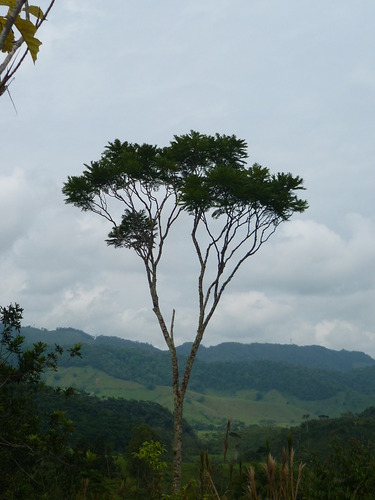
It reaches up to 24 metres (79 ft) in height, with a rounded crown, thick trunk, and spreading, low-branching limbs.
Bark Appearance
When young, its bark is grey and smooth; on older trees it peels, and becomes dark grey to light brown and scaly, with creamy-white inner bark.
Branch and Bark Characteristics
Branches are marked with lenticels, and bark can be as thick as 6 mm (0.24 in) on a 15 cm (5.9 in) diameter branch.
Wood Properties
The wood of Kigelia africana is pale brown or yellowish, undifferentiated, and not prone to cracking.
Habitat Preferences
This tree grows mostly wild, most often in wetter habitats including rainforest, woodland, wetter savanna, and shrubland, on loamy red clay soil that may be rocky.
Altitudinal Range
It occurs at altitudes from sea level up to 3,000 m.
Traditional Medicinal Use
Local African tribes have traditionally used this tree based on the belief that it helps treat various disorders.
Phytochemical Content
It contains a wide range of phytochemicals: phenols, coumarins, sterols, triterpenes, diterpenes, unsaturated fatty acids, quinones, iridoids, alkanes, and esters.
Botswana Timber Uses
In Botswana, its timber is used to make makoros, yokes, and oars.
General Wood Applications
More broadly, the wood is used as fuel, for constructing canoes, planks, and fence posts, and for crafting a variety of household items including containers, musical instruments, furniture, and tool handles.
Branch Uses
Branches are used to make bows.
Wood and Fruit Carving Uses
Both wood and fruit are carved into objects such as traps, toys, and dining utensils, and wood also serves as fuel.
Dye Production
The tannin-rich fruit pulp produces a black dye for colouring.
Prehistoric Wood Use
Archaeological evidence shows early use of Kigelia africana wood for wedge-shaped tools at Kalambo Falls, Zambia, between 390,000 and 324,000 years ago.
Traditional Alcoholic Beverage
Around Mount Kenya, the Kikuyu, Embu, and Akamba peoples use dried fruit to produce an alcoholic mead called muratina in Kikuyu.
Muratina Preparation Process
To make the beverage, harvested fruit is split lengthwise, soaked to reduce bitterness, sun-dried, combined with cane sugar, then fermented for 2 to 4 days in a warm place, resulting in a final ethanol content of 3 to 6%.
Ornamental Cultivation
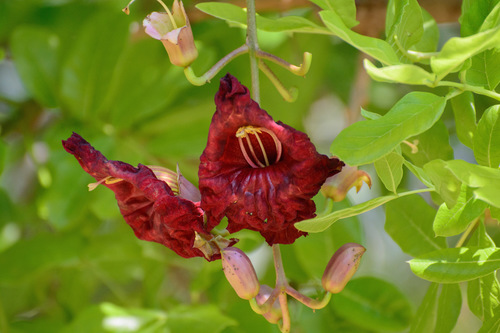
Kigelia africana is widely cultivated as an ornamental tree in tropical regions, valued for its decorative flowers and unusual fruit.
Cultural and Spiritual Significance
It also carries major cultural and spiritual importance for many African communities.
Talisman Use
It is considered sacred, and its fruit is widely traded in local markets as a talisman believed to bring good luck in many circumstances.