About Batrachostomus moniliger Blyth, 1849
Length
This bird species reaches 23 centimetres (9.1 in) in length.
Head and Bill Morphology
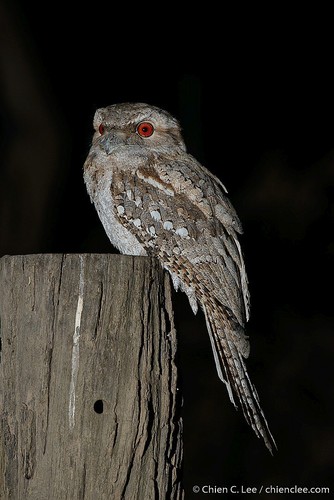
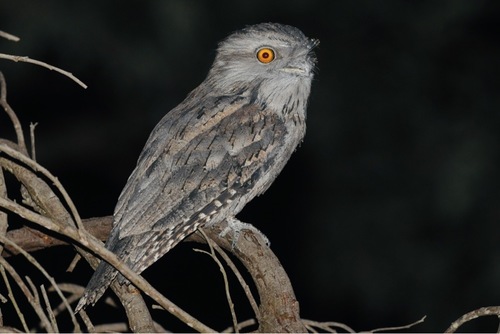
Like all frogmouths, it has a wide, hooked bill with slit-like nostrils, and a large head with forward-facing eyes that give it a wide field of binocular vision.
Wing Structure and Markings
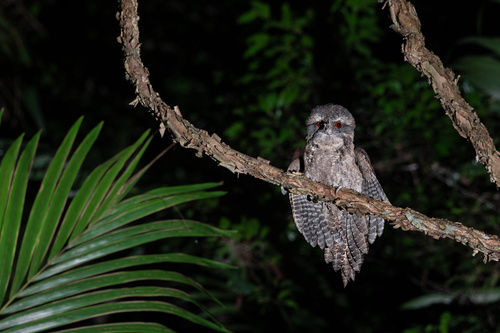
Compared to other species in its genus, it has small wings; these wings are marked by wing coverts that end in black spots tipped with white.
Male Plumage
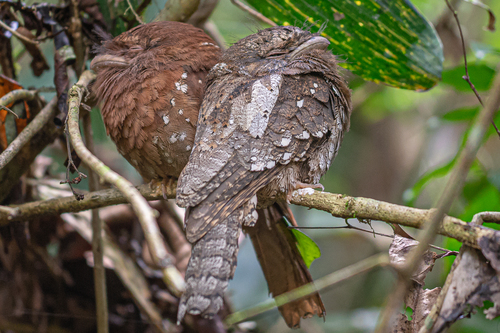
Males are gray-brown with fine barring and a spotted crown; some males are browner and more closely resemble females.
Female Plumage Base Coloration
Females are more rufous or chestnut brown.
Geographic Variation in Female Crown Markings
Female birds from India have very fine black speckles on the crown, while Sri Lankan females may lack this speckling or have it in reduced form.
Periocular Bristles
This bird also has short, stiff bristles in front of and surrounding its eyes.
Subspecies Roonwali Identification
The population in the Western Ghats, subspecies roonwali (named after Mithan Lal Roonwal), differs very slightly from the nominate form.
Roonwali Male Plumage Differences
Male roonwali have a brownish-grey wing mirror and yellowish spots on the undersides, while nominate males from Sri Lanka have grey or white spots in these areas.
Roonwali Female Plumage Differences
Female roonwali have a bright reddish-brown wing mirror and unspotted undersides to the wings.
Species Distribution Range
This species is found in the Western Ghats of southwest India and Sri Lanka.
Habitat Preferences
It inhabits tropical forest, typically with dense undergrowth, and can sometimes be found in more disturbed habitats including plantations.
Detection Difficulty Factors
Its presence is easily overlooked because of its nocturnal behaviour and effective camouflage.