About Basiliscus plumifrons Cope, 1875
Common Names and Genus Status
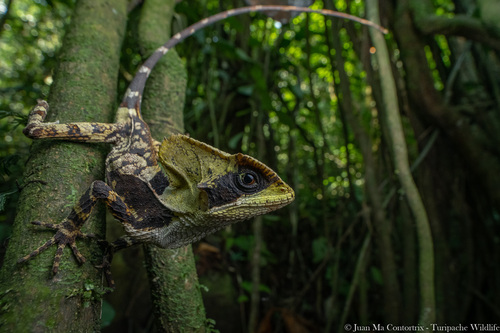
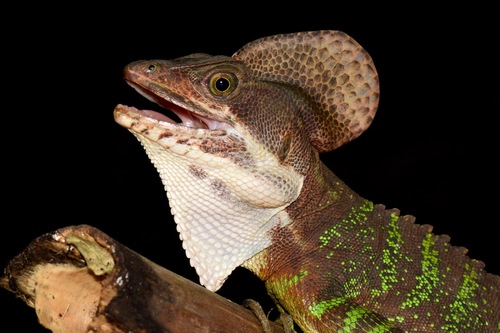
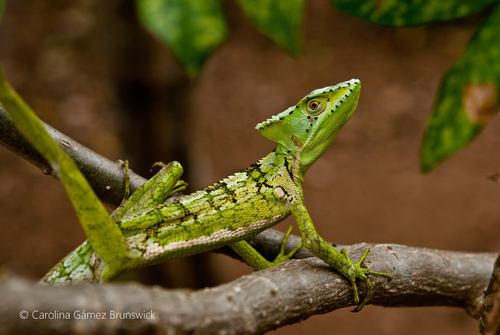
Basiliscus plumifrons, commonly called the plumed basilisk or green crested basilisk, is the largest species in the Basilisk genus.
Size Measurements
Adults have an average snout-to-vent length (SVL) of 10 inches (25 cm), and reach a total length of 3 feet (91 cm) when including the tail.
Typical Adult Coloration
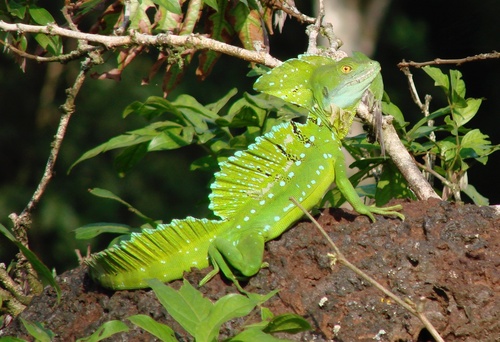
Most adult individuals are bright green with bright yellow irises, small bluish spots along the dorsal ridge, and underbellies that are a lighter green than the rest of the body.
Alternative Color Morphs
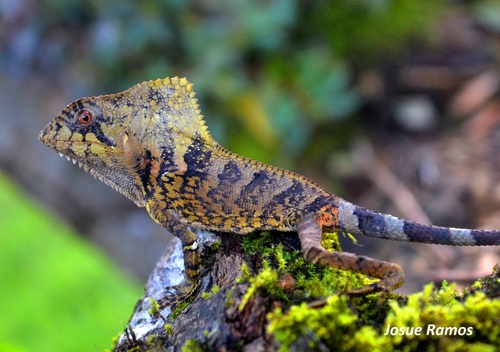
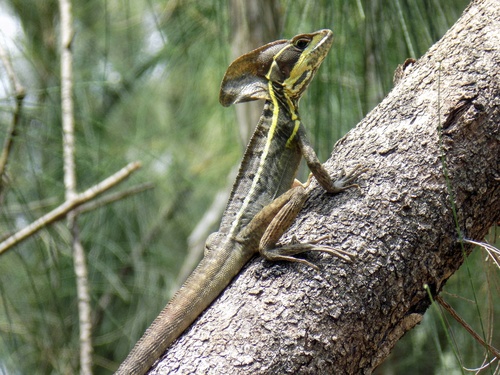
Some alternative forms or subspecies have only black markings along the dorsal side, while others may have varying streaks of white, dark grey, and blue markings across the body.
Head Shape and Ear Openings
In profile, the head is triangular, with ear openings that are slightly larger than the eyes.
Eyes and Skin Scales
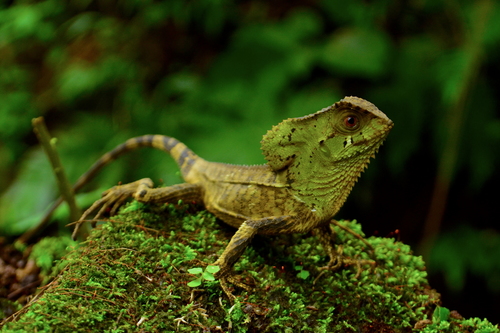
The species has round eyes with round pupils, and its skin is covered primarily in small granular scales.
Locomotion Adaptations
The hind legs are longer than the front limbs, and the toes are flattened and laterally oriented; both adaptations help the lizard run across water.
Male Crest Structure
Males have either three or four prominent crests: sources describe either one on the head, one on the back, and one on the tail, or one atop the head crown, one between the eyes, one dorsal, and one on the tail.
Female and Juvenile Crests
Females have reduced crests, with either only the head crest, or a reduced head crest and reduced tail crest; juvenile plumed basilisks share the female crest pattern and have less conspicuous coloration, and lack fully developed characteristic crests.
Male Crest Development Timeline
Juvenile males begin developing their characteristic large crests between six months and over one year after hatching, depending on the juvenile's body condition.
Native Geographic Range
The plumed basilisk is native to Central America and northern South America.
Detailed Distribution
Its native range originally was noted as rainforests near running streams in southern Mexico and northern Colombia, but evidence confirms it occupies the Atlantic versant from eastern Honduras to western Panama, and has also been sighted along the Pacific coast of southwestern Costa Rica.
Habitat Preferences
It prefers hot, humid, moist lowland mature wet forests located near running streams, and requires agroforestry systems with integrated tree cover for species preservation.
Activity Pattern and Habitats
Widespread and abundant in Central America, this arboreal, diurnal species is also aquatic, found commonly in inland rivers, streams, ponds, and lakes, as well as on beaches and seashores.
Perching Locations
It is most often found in trees or perched on boulders near bodies of water.
Preferred Body Temperature
It prefers a body temperature of 31.7 ± 0.5 °C (89.1 ± 0.9 °F).
Female Pre-Egg-Laying Display
During the week before egg-laying, sexually mature females approach males and display by positioning themselves roughly 0.5 m (1 ft 8 in) from the male, lowering their forebody to the ground, and raising their pelvic region and tail.
Post-Fertilization Female Appearance
Females become visibly plump one to two weeks after fertilization.
Nesting Site Search Timeline
In the third week after fertilization, they begin searching for a nesting site.
Captive Nesting Observation
One captive female was observed digging nesting holes in soil six months before ovipositing, well ahead of the breeding season.
Typical Clutch Size and Nest Substrate
Females typically lay between 5 and 17 eggs per clutch in warm, damp sand or soil.
Clutch and Egg Size Variability
Clutch size and egg size vary based on the mother's age, health, and size.
Annual Clutch Frequency
Females can lay up to four or five clutches in a single breeding season.
Incubation and Hatching Timeline
Eggs incubate for eight to ten weeks, and hatching occurs over one to two days.
Hatchling Traits
Hatchlings are fully independent immediately after emerging, with an average SVL of 43 mm (1.7 in) and an average weight of roughly 2 grams (0.071 oz).