About Avicennia alba Blume
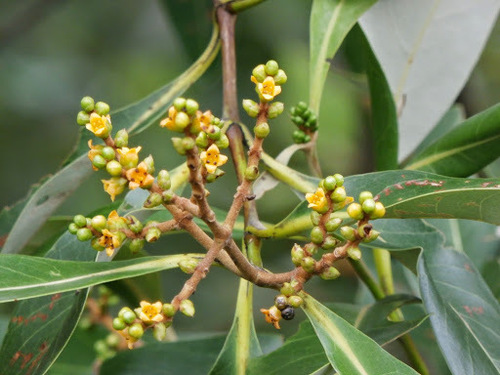
Avicennia alba Blume forms a low, dense bushy crown, and often branches near the base of its trunk. It does not grow taller than about 20 m (66 ft). Its roots are shallow and produce many pencil-shaped pneumatophores, which are aerial roots. These pneumatophores facilitate gas exchange and play an important role in excluding salt from the plant's vascular system. The trunk has smooth, greenish-black bark that is finely fissured and does not flake off. The dark green leaves are 15 cm (6 in) long and 5 cm (2 in) wide, have a silvery grey underside, and grow in opposite pairs. Its small, orange-yellow flowers grow in racemose inflorescences, have four petals, and reach about 4 mm (0.16 in) in diameter when fully expanded. The fruits are greyish-green conical capsules with an elongated beak that can grow up to 4 cm (1.6 in) long, and each fruit holds a single seed. In the Malay language, this species is called api api putih: api means "fire", a reference to this mangrove attracting fireflies, while putih means "white", referring to the pale underside of its leaves. Avicennia alba is distributed across South Asia, Southeast Asia, the islands of the South Pacific Ocean, and Australia. It is common in the Sungei Buloh Wetland Reserve in Singapore. It grows in tidal sections of riverbanks and on muddy parts of the seashore. It is a pioneering species, and is one of the first species to colonize new ground. Its widespread root system with numerous pneumatophores helps stabilize newly deposited sediment. A variety of invertebrates are associated with Avicennia alba. Larvae of the small moth genus Euopoicillia feed on its flower buds, and larvae of the moth Autoba alabastrata feed on its fruits. Its leaves are eaten by beetles of the genus Monolepta. Mangrove swamps host the greatest number of known marine fungus species, and Avicennia alba is one of several mangrove species that these fungi colonize. Avicennia alba is a fast-growing species, and is sometimes planted alongside Sonneratia and Rhizophora to help prevent coastal erosion. Its timber does not make good firewood or charcoal, but it is used to smoke rubber and fish. An extract of the heartwood is used in herbal medicine to make a tonic, and the plant's resin has been used in birth control. Its seeds are boiled and eaten as a vegetable, and are sometimes sold in local markets.