About Carlowrightia torreyana Wassh.
Taxon Introduction
Torrey's wrightwort (Carlowrightia torreyana Wassh.) has the following key distinguishing features.
Growth Form
It is a perennial plant with a growth form that falls between an herb and a woody shrub: it has a woody base and non-woody upper stems. Stems can grow along the ground or bend upward to reach around half a meter (about 1⅔ feet) tall.
Leaf Arrangement
Its leaves have petioles, are arranged opposite one another, and have leaf blades that range from broadly egg-shaped to round.
Leaf Size
Blades can grow up to 40 mm (about 1½ inches) long, but are usually around half that maximum length.
Calyx Structure
The calyx has 5 lobes (sepals), rather than 4.
Corolla Features
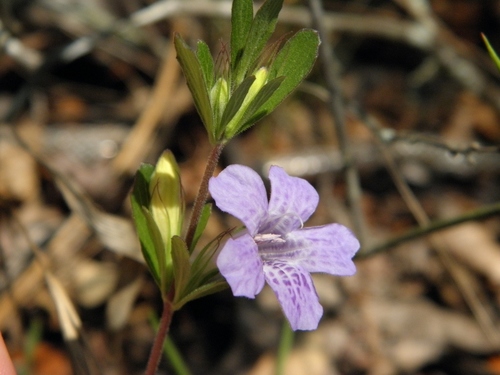
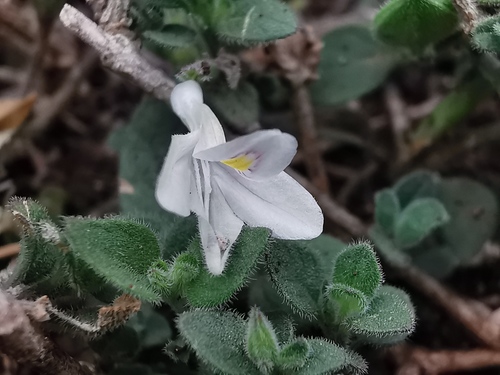
The white corollas are only 7 to 9 mm (about ¼ to ⅜ inch) long, and are distinctly split into an upper lip and a lower lip. The lower lip is prominently 3-lobed, while the upper lip bears a yellow "eye" edged with maroon.
Stamen Characteristics
Flowers have 2 stamens (not four), and the stamens are positioned closer to the corolla's lower lip than to the upper lip.
Bractlet Traits
The small bractlets located below each flower are not fused along one side from base to apex.
Fruit Characteristics
The plant produces capsular fruits that are 8 to 12 mm (about 5⁄16 to ½ inch) long.
United States Distribution
In terms of distribution, Torrey's wrightwort occurs in southwestern Texas in the United States.
Mexico Distribution
In Mexico, it grows in the north-central and northeastern states of Chihuahua, Sonora, Coahuila, and Nuevo León.
Texas Habitat
For its habitat, in Texas, Torrey's wrightwort grows on igneous rock and limestone slopes, ledges, and plains.
Voucher Specimen Context
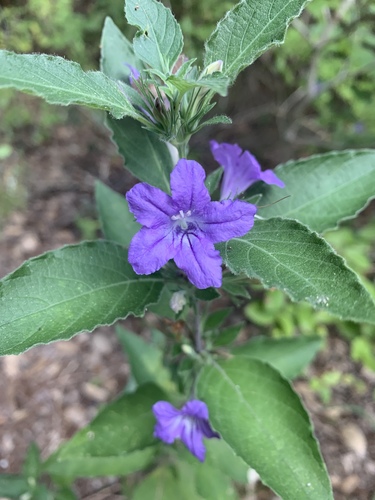
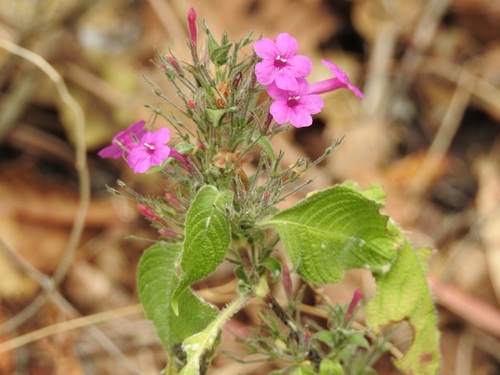
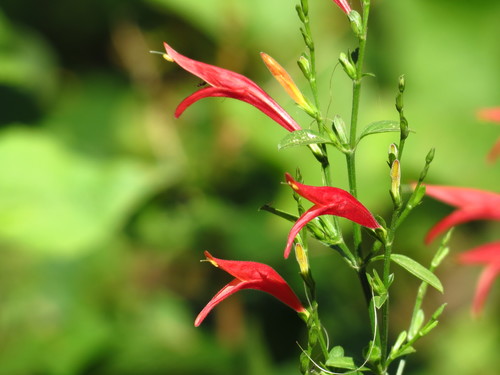
The photographs on this page show an individual growing in Texas, in thin soil atop limestone on a forested slope at the southern edge of the Edwards Plateau, at an elevation of approximately 1750 m (about 5750 ft).
Mexico Habitat
In Mexico, this species has been collected from a rocky, limestone valley.