About Ateuchosaurus chinensis Gray, 1845
Common Name & Body Shape
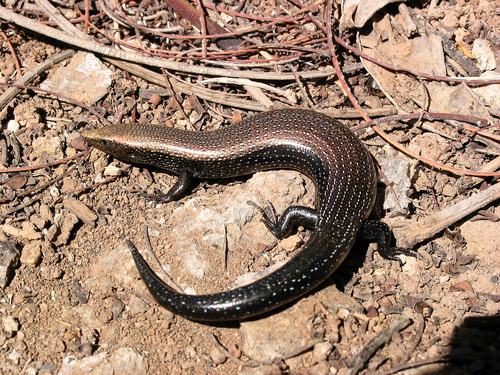
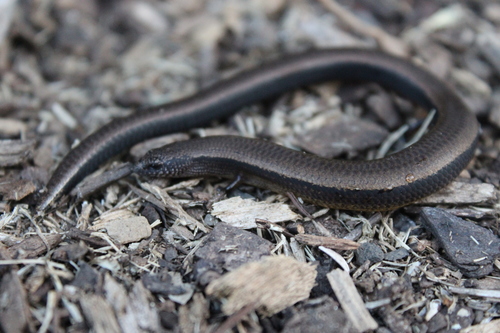
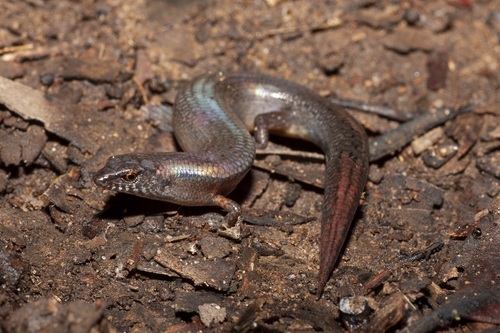
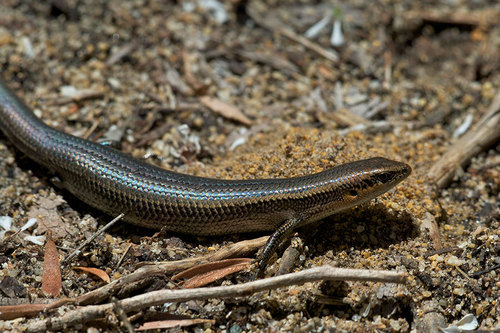
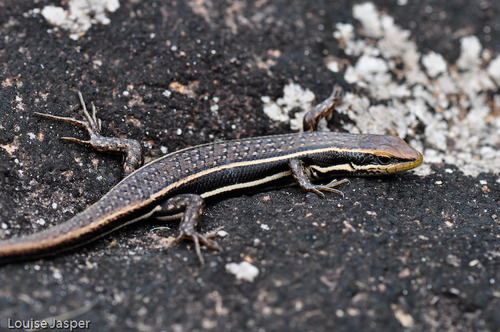
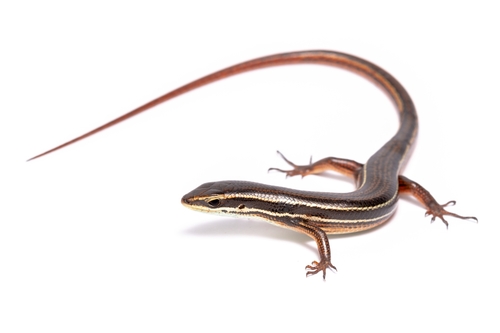
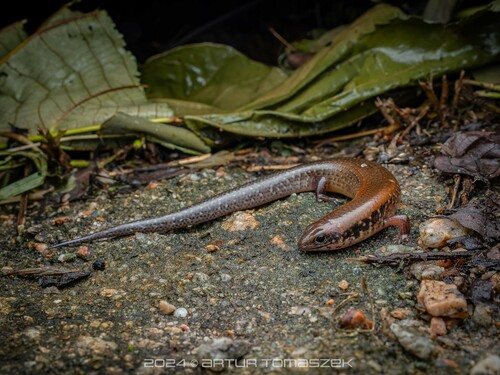
Ateuchosaurus chinensis, commonly known as the Chinese short-limbed skink, has an elongated body.
Snout-Vent Length
Females have a snout-vent length of 70–80 mm, while males have a snout-vent length of 82–83.8 mm.
Tail Characteristics
Its tail is longer than the body, though regenerated tails are typically shorter.
Limb Structure
This species has short, pentadactyl limbs, and its fingers and toes are widely separated when pressed against the body.
Snout Morphology
The snout is short and obtuse.
Coloration
Its dorsal color is brownish, with a cream or yellowish white underside, and black and white spots along its flanks.
Overall Distribution
This skink is endemic to Vietnam, and southern and central China.
Vietnam Distribution
In Vietnam, it was first recorded only in the Mau Son Mountains of Lạng Sơn province, and has since been discovered in secondary forests in Bắc Giang province and Hà Giang province.
China Distribution
In China, it has been recorded in Fujian, Guangdong, Guizhou, Hong Kong, Hainan, and Nan'ao Island.
Habitat
It is a terrestrial species that inhabits leaf litter on the forest floor of secondary forests, and mixed bamboo and hardwood forests.
Reproductive Mode
The Chinese short-limbed skink is oviparous, and lays several eggs per clutch.
Reproductive Timing Hypothesis
It has been hypothesized that the species yolks eggs during the monsoonal season, and eggs hatch late in the season; if this hypothesis holds, females likely do not lay eggs until they reach approximately 23 months of age.
Vietnam Egg-Laying Period
In Vietnam, the species probably lays eggs between June and September, during the local rainy season.