About Astrochelys radiata (Shaw, 1802)
Adult Size
Adult Astrochelys radiata (radiated tortoises) typically measure 26 to 38 centimetres (10 to 15 in) in carapace length, and weigh 2.5 to 8.8 kilograms (5.5 to 19.4 lb), with the largest individuals usually being male.
General Body Shape
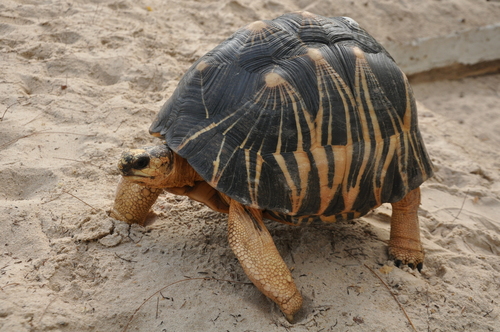
This species has the characteristic body shape of a tortoise, with a high-domed carapace, a blunt head, and elephantine feet.
Head and Limb Coloration
Its legs, feet, and head are yellow, with the exception of a variably sized black patch on the top of the head.
Carapace Pattern Origin
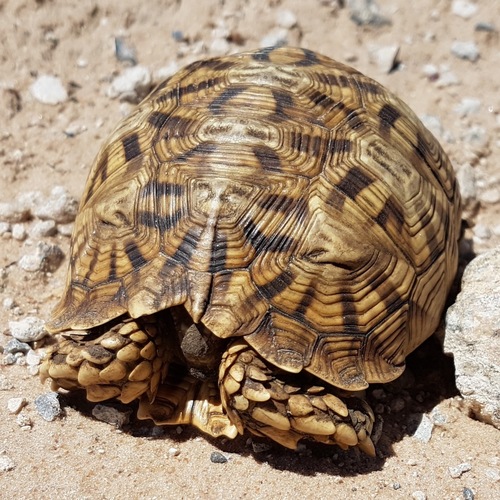
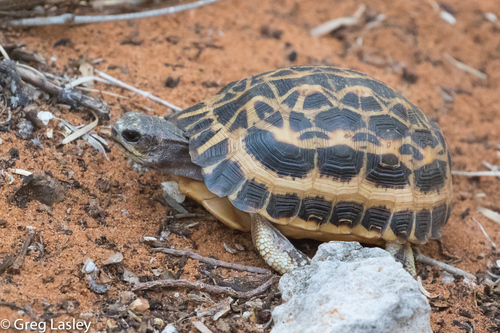
The radiated tortoise gets its name from the bright yellow lines that radiate out from the center of each dark shell plate on its carapace.
Comparison to Related Species
Compared to other star-patterned tortoise species like India's Geochelone elegans, the star pattern of the radiated tortoise is more finely detailed and intricate. It is also larger than G. elegans, and its carapace scutes are smooth, rather than raised into a bumpy, pyramidal shape that is common in G. elegans.
Sexual Dimorphism
Sexual dimorphism in this species is slight: male radiated tortoises usually have longer tails than females, and the notches under their tails are more noticeable.
Geographic Distribution
Radiated tortoises naturally occur only in the extreme southern and southwestern part of the island of Madagascar, and have been introduced to the nearby islands of Reunion and Mauritius.
Habitat Preference
They favor dry regions of brush, thorn (Diderae) forests, and woodlands in southern Madagascar.
General Diet Composition
Radiated tortoises are herbivores; grazing makes up 80 to 90% of their diet, and they also eat fruits and succulent plants.
Preferred Food Source
A preferred wild food source for them is the Opuntia cactus.
Grazing Behavior
They graze regularly in the same area, which keeps the vegetation there closely trimmed, and they tend to prefer new plant growth over mature growth due to the new growth's high protein and low fiber content.
Mating Size Thresholds
For reproduction, males first mate once they reach a carapace length of about 12 inches (31 cm), while females usually need to be a few inches longer to mate.
Initial Mating Behavior
Males begin the fairly noisy mating process by bobbing their head and smelling the female's hind legs and cloaca. In some cases, the male may lift the female up with the front edge of his shell to stop her from moving away.
Mating Mounting Process
The male then mounts the female from the rear, and strikes his anal plastron region against the female's carapace. It is common for males to hiss and grunt during mating.
Mating Risk
This process can be very dangerous, and there are recorded cases where the female's shell cracked and pierced her vaginal and anal cavities.
Egg Laying Behavior
After excavating a hole 6 to 8 inches (15 to 20 cm) deep, females lay between three and twelve eggs in the hole and then leave.
Incubation Period
The incubation period for this species is quite long, usually lasting between 5 and 8 months.
Hatchling Size
Newly hatched juveniles are between 1.2 and 1.6 inches (3.2 and 4 cm) long.
Juvenile Coloration
Unlike the yellow coloration of adult radiated tortoises, juveniles are white to off-white.
Juvenile Shell Development
Juveniles develop the characteristic high-domed carapace soon after hatching.