About Astragalus trichopodus (Nutt.) A.Gray
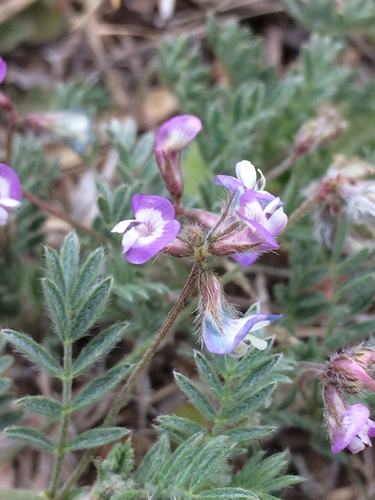
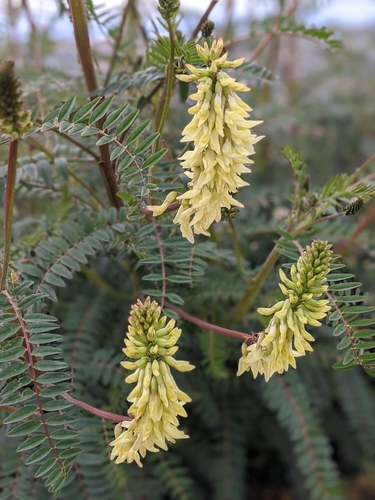
Astragalus trichopodus (Nutt.) A.Gray is a robust perennial herb. It grows a branching stem reaching up to about one meter in maximum height. The hairy stem bears many leaves, each up to 20 cm (7.9 in) long. Each leaf is composed of several pairs of widely spaced lance-shaped leaflets, each up to 2.5 cm (0.98 in) in length. Its inflorescence is a raceme holding up to 50 cream-colored flowers, which are sometimes tinted light purple. Each flower is 2 to 3 cm (0.79 to 1.18 in) long, including its tubular sepal base. This species blooms from February to June.
The fruit is a laterally compressed, slightly inflated legume pod that grows 4 to 5 cm (1.6 to 2.0 in) long, drying to a papery texture. The fruits develop from the inflorescence and hang in bunches, and each pod contains many seeds. This plant is native and endemic to southern California, with its range extending into Baja California. It grows in coastal sage scrub and grassland plant communities, and is most commonly encountered during the months of March, April, and May. Its global conservation status is G3, meaning it is classified as vulnerable.
Ecologically, Astragalus trichopodus supports multiple butterfly species, and acts as a host plant for Reakirt's blue, arrowhead blue, marine blue, Queen Alexandra's sulphur, and the critically endangered Palos Verdes blue butterfly. The species was once thought to be the only host plant for Palos Verdes blue butterflies, but larvae have since been recorded feeding on Acmispon glaber as well.