About Aspidoscelis tigris (Baird & Girard, 1852)
Common Name and Body Scales
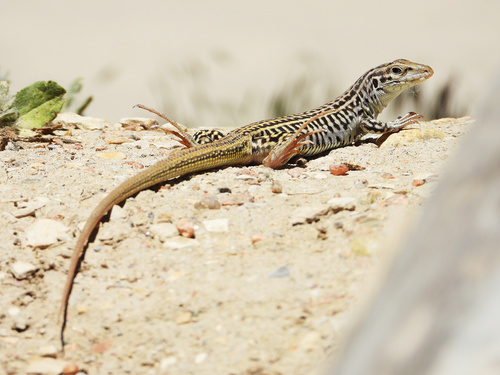
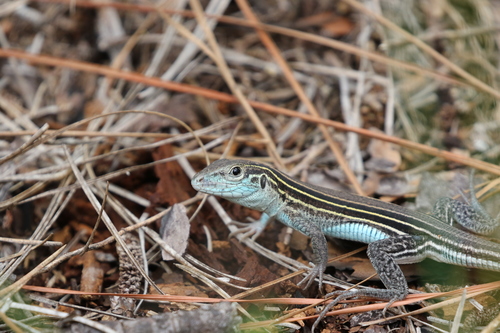
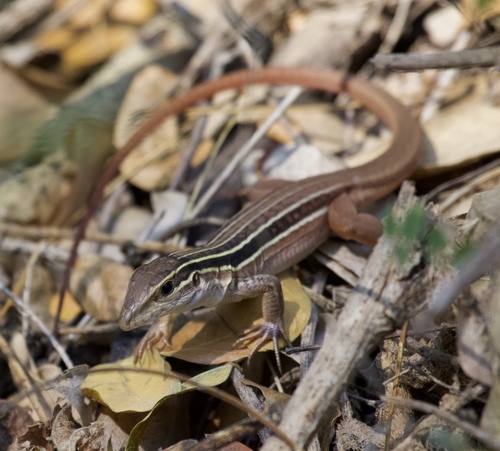
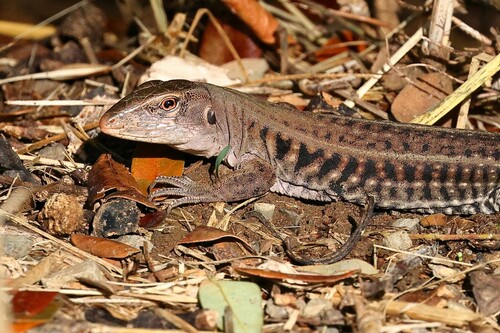
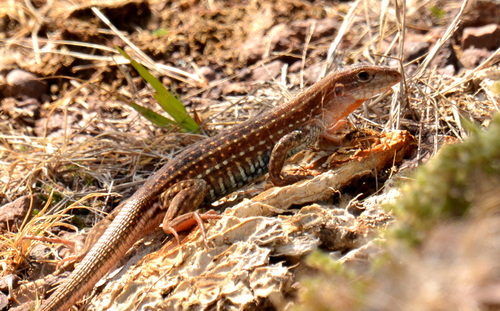
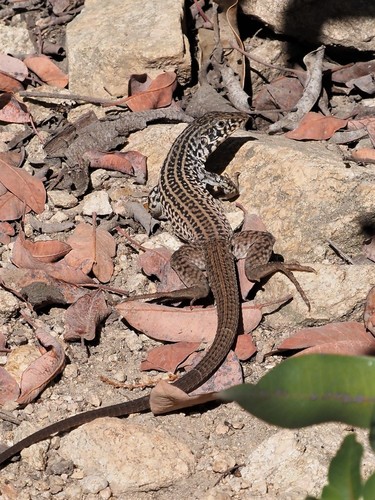
Aspidoscelis tigris, commonly known as the western whiptail, has a long, slender body, with small grainy scales on its back and larger rectangular scales on its belly.
Upper Body and Throat Coloration
Its upper side often has light stripes, and adult individuals may have pinkish or faintly orange throats.
Adult Size
The maximum snout-to-vent length (SVL) is 102 mm (around 4 inches), and the maximum total length including the tail is 305 mm (around 12 inches).
Hatchling Coloration
Hatchlings are orange-yellow, marked with dark brown to black spots or stripes.
Geographic Range
The western whiptail is widespread across northern Mexico and the western United States; within the US, it occurs in Arizona, California, Colorado, Idaho, Nevada, New Mexico, Oregon, and Utah.
General Habitat
It inhabits hot, dry regions, typically with sparse foliage, and can be found in woodland, chaparral, riparian areas, or desert.
Desert Subspecies Habitat
Desert-dwelling subspecies prefer habitats with vegetation such as sagebrush or shadscale, and use burrows to escape desert heat.
Northern Range Seasonal Activity
In the northern parts of its range, western whiptails usually emerge from hibernation in May, and most adults enter aestivation during midsummer.
Southern Range Seasonal Activity
In the southern parts of its range, the species is active from April through late August.
Seasonal Active Period Comparison
This makes the annual active period considerably shorter in the north than in the south.
Daily Activity Patterns
Daily activity periods have similar duration across the northern and southern parts of the range, though emergence tends to happen later in the day in northern areas.
Ploidy Trait
The western whiptail is polyploid based on its chromosome makeup.
Reproductive System
It is also a bisexual species, with both males and females, which differs from other Aspidoscelis species that consist entirely of females.
Northern Range Reproductive Timing
In the northern end of its range, mating typically takes place in the first half of June, and females start laying eggs in late June.
Northern Range Egg Laying and Hatching
Eggs usually hatch by mid-August, and females lay only one clutch of eggs per year.
Southern Range Egg Timing
In the southern end of its range, females may start laying eggs as early as May, and eggs may hatch as early as mid-June.
Southern Range Clutch Frequency
Southern females may also lay two clutches per year instead of one.