About Aspidoscelis gularis (Baird & Girard, 1852)
Size
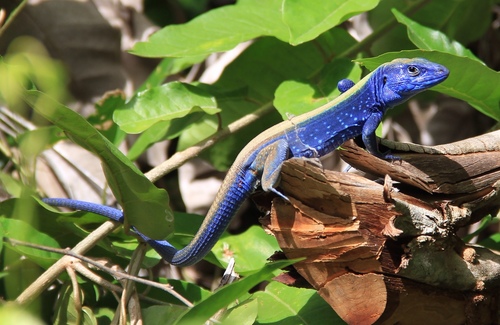
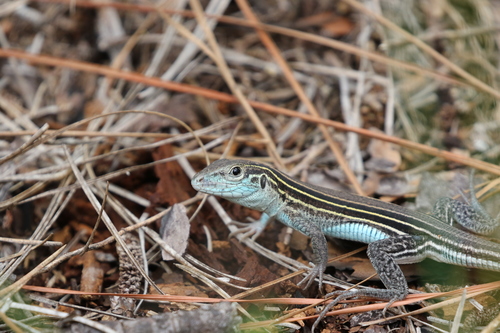
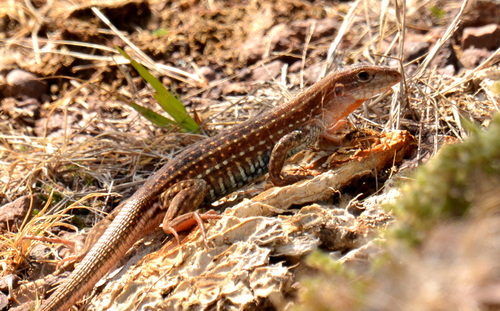
Aspidoscelis gularis, commonly known as the Texas spotted whiptail, reaches a total length (including the tail) of 6.5 to 11 inches, which is 17 to 28 cm.
Dorsal Base Coloration
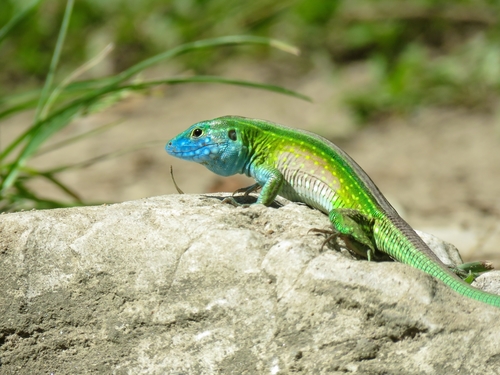
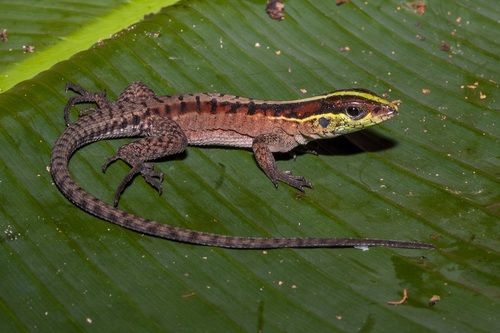
Its base color is typically tan, brown, or green-brown.
Dorsal Stripe Pattern
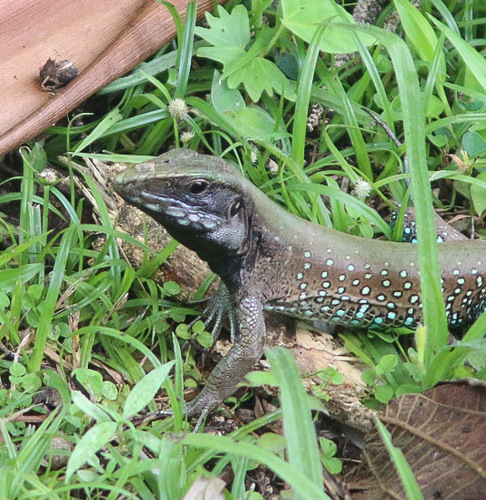
It has seven distinct grey or white stripes that run along the full length of its body and end at the tail, with light-colored spots along its sides.
Ventral Base Coloration
Its underside is a uniform solid white.
Sexual Dimorphism in Coloration
Males often have a red throat, blue belly, and black or blue patches on the chest, while females only have a pink-colored throat.
Tail Characteristics
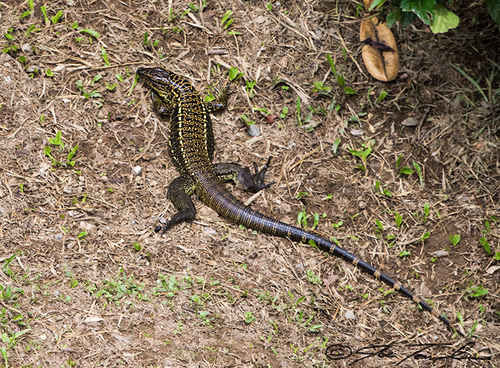
Its tail is long relative to its body, usually close to three times the length of the body, and is typically a uniform peach or tan color.
Distribution
This species is found in the U.S. states of New Mexico, Oklahoma, and Texas, as well as the following Mexican states: Aguascalientes, Campeche, Coahuila, Guanajuato, Hidalgo, Jalisco, Michoacán, Nuevo León, Querétaro, San Luis Potosí, Tamaulipas, and Veracruz.
Activity and Diet
A. gularis is diurnal and insectivorous, and is highly active.
Habitat Preferences
It occupies a wide range of habitats including grassland, semi-arid regions, canyons, and rocky terrain, and is usually found not far from a permanent water source.
Anti-Predator Adaptation
Like many other whiptail lizards, it can perform tail autotomy, shedding its tail to escape predators.
Reproduction
Breeding occurs in spring for sexually mature A. gularis, and a clutch of 1 to 5 eggs is laid in early summer.